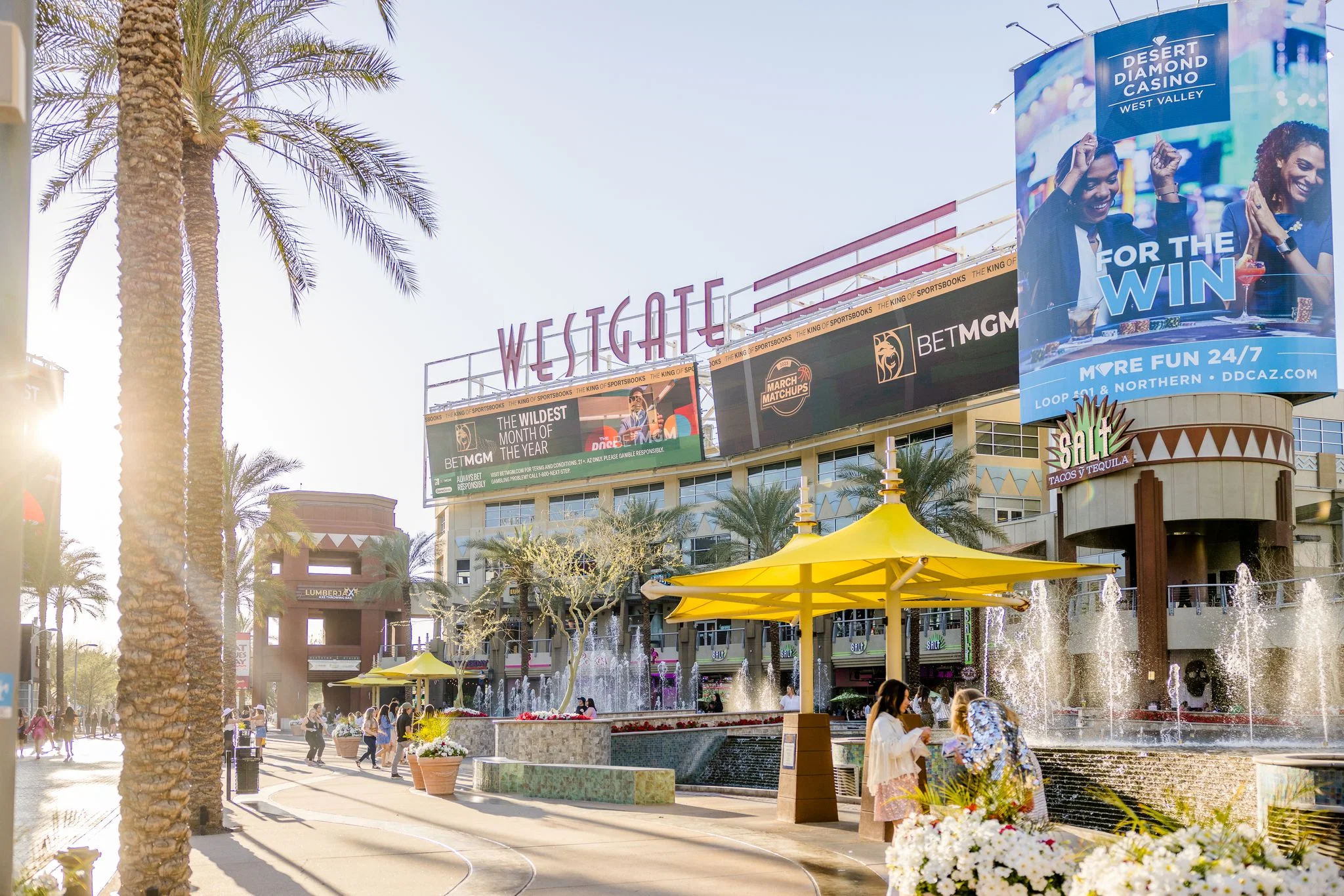
Strong planning covers trade show and event planning for exhibitors and planners working in and around the Westgate entertainment district in Glendale, Arizona. Westgate is a planning reference, built for practical show execution. It focuses on freight routing between Westgate and the primary Phoenix Convention Center campus, hotel inventory along the Loop 101 corridor, and how Westgate's arena and stadium venues interact with the broader Valley event calendar.
The Westgate district runs along Loop 101 about fifteen miles northwest of Phoenix Convention Center. State Farm Stadium seats approximately 63,400 and can expand to over 72,000. Desert Diamond Arena serves as a second anchor venue. Hotel inventory clusters around the Loop 101 and Glendale Avenue interchange, positioning Westgate as overflow lodging when downtown Phoenix or Scottsdale properties book solid during high-demand periods. Freight to or from Westgate typically routes via Loop 101 to I-10 eastbound, with drive time ranging from twenty-five minutes off-peak to over an hour during evening commute windows.
Planning around Westgate requires coordinating with the venue-specific workflows at State Farm Stadium and Desert Diamond Arena, understanding how Loop 101 traffic patterns affect delivery timing, and confirming whether your event operates in Westgate itself or uses Westgate hotel inventory to support a show running elsewhere in the Valley. The section below outlines freight routing, hotel block logistics, and the jurisdictional details that come up when Westgate serves as a planning component of a larger Phoenix-area event.
Westgate District Event Planning: Logistics and Coordination Points
- Loop 101 freight timing between Westgate and Phoenix Convention Center runs twenty-five to thirty minutes off-peak, stretching past an hour when routed through the 3:30–7:00 PM I-10 eastbound corridor
- State Farm Stadium seats approximately 63,400 and can expand to over 72,000, creating a venue scale that drives sponsor activation demand and consumer-show overflow logistics distinct from convention-center workflows
- Desert Diamond Arena and State Farm Stadium each operate under their own house services and contractor jurisdiction, requiring advance coordination with venue management before finalizing exhibit or activation installation schedules
- Hotel inventory along Loop 101 and Glendale Avenue positions Westgate as a lodging overflow option for downtown Phoenix or Scottsdale events, with shuttle coordination and drive-time math becoming critical planning inputs
- The Westgate entertainment district supports sponsor activations, consumer shows, and arena-adjacent events, but does not host traditional trade-show floor programs at the scale of Phoenix Convention Center or WestWorld of Scottsdale
Freight Routing and Drive-Time Math: Loop 101 to Phoenix Convention Center
Freight moving between Westgate and Phoenix Convention Center typically routes via Loop 101 southbound to I-10 eastbound, then exits at Seventh Street or Third Street depending on which dock serves your show. Off-peak timing from Westgate to the Phoenix Convention Center North Building docks runs twenty-five to thirty minutes. Inside the weekday 6:30–9:30 AM and 3:30–7:00 PM windows, the I-10 eastbound corridor through downtown Phoenix slows substantially, stretching the same run to fifty-five minutes or longer. Planners coordinating load-in for a Phoenix Convention Center show while housing crews or staging freight at Westgate properties need to account for this variability when building delivery schedules.
The Phoenix Convention Center North Building includes 635,000 square feet of meeting and exhibition space, eleven exhibit halls, fifty-six meeting rooms, and twenty climate-controlled loading docks. Dock assignments and advance receiving schedules are managed by the official show contractor and the venue's house services team. If your freight originates from Westgate or routes through a Westgate-area warehouse, confirm dock availability and the advance receiving window before committing to a delivery slot. Missing a dock window because of traffic delays can push your load-in into a later shift or force repositioning at a premium rate.
Return freight from Phoenix Convention Center to Westgate follows the reverse route: I-10 westbound to Loop 101 northbound. The westbound I-10 corridor through downtown Phoenix experiences its own congestion during evening hours, though typically lighter than the eastbound flow. Planners should build at least a forty-five-minute buffer into strike-day schedules when routing freight back to Westgate, particularly if you are coordinating multiple loads across a tight timeline.
- Loop 101 southbound to I-10 eastbound via the Seventh Street or Third Street exits serves Phoenix Convention Center dock access from Westgate
- Phoenix Convention Center North Building offers twenty climate-controlled loading docks, with advance receiving managed by the official show contractor and house services
- Off-peak drive time from Westgate to Phoenix Convention Center docks runs twenty-five to thirty minutes; inside peak windows the run can exceed fifty-five minutes
- Return freight routing I-10 westbound to Loop 101 northbound requires a forty-five-minute buffer during evening hours to account for downtown Phoenix congestion
State Farm Stadium and Desert Diamond Arena: Venue Workflows and Jurisdiction
State Farm Stadium seats approximately 63,400 and can expand to over 72,000, positioning it as a venue for large-scale sponsor activations, consumer shows, and arena-adjacent events rather than traditional trade-show floor programs. The stadium operates under its own house services and official contractor jurisdiction. Exhibitors or activation teams planning installations at State Farm Stadium must coordinate load-in timing, rigging access, power distribution, and freight dock assignments with the venue's operations team and the designated contractor well in advance. The venue does not follow the same advance order or material handling workflows as Phoenix Convention Center, so planners accustomed to convention-center processes should expect different documentation requirements and timeline expectations.
Desert Diamond Arena serves as a second anchor venue in the Westgate district, hosting concerts, sporting events, and smaller-scale consumer shows. Like State Farm Stadium, Desert Diamond Arena operates under its own contractor and house services framework. Exhibitors planning booth installations, sponsor activations, or pop-up retail programs inside the arena must confirm jurisdiction with the venue before signing vendor contracts. Coordination typically involves the venue's event services team, the official show contractor if one is designated, and any Exhibitor Appointed Contractors you bring in to handle custom booth builds or AV installations. Failing to confirm jurisdiction early can result in labor disputes, delayed installations, or unexpected fees when multiple contractors claim overlapping scope.
Both venues require advance coordination for freight delivery. State Farm Stadium's dock infrastructure is designed for large-scale event logistics, but access windows are tightly controlled around the stadium's event calendar. Desert Diamond Arena operates under similar constraints. Planners should request dock schedules and load-in windows at least six weeks before your event date, particularly if your installation involves rigging, custom staging, or heavy equipment that requires extended setup time.
- State Farm Stadium seats approximately 63,400 and can expand to over 72,000, creating a venue scale suited to sponsor activations and consumer shows rather than traditional trade-show floor programs
- Desert Diamond Arena operates under its own contractor and house services jurisdiction; confirm scope and labor assignments with the venue's event services team before signing vendor contracts
- Freight dock access at both State Farm Stadium and Desert Diamond Arena is tightly controlled and must be coordinated with the venue's operations team at least six weeks before your event date
Hotel Inventory and Overflow Lodging: Westgate as a Supporting Market
Hotel inventory around Westgate clusters along Loop 101 and Glendale Avenue, positioning the district as overflow lodging when downtown Phoenix or Scottsdale properties book solid during high-demand periods. Phoenix Convention Center events, WestWorld of Scottsdale shows, and Talking Stick Resort conferences can all generate demand that exceeds the walkable hotel inventory around their respective venues. When that happens, Westgate properties serve as a secondary option. Planners coordinating hotel blocks split between downtown Phoenix and Westgate need to account for shuttle logistics, drive-time variability, and attendee expectations around commute burden.
Downtown Phoenix to Westgate via I-10 westbound and Loop 101 northbound runs approximately fifteen miles and takes twenty-five to thirty-five minutes off-peak. Inside weekday rush windows, the drive can stretch past fifty minutes. If you are housing VIP attendees or speakers at Westgate while your event runs downtown, shuttle timing becomes a critical planning input. A 9:00 AM session start requires departure from Westgate no later than 8:00 AM during weekday peak traffic, which may conflict with morning meal service or breakfast networking plans. Similarly, evening sessions ending at 6:00 PM will hit the return commute window, adding delay and attendee frustration.
Westgate to Scottsdale routing via Loop 101 eastbound serves WestWorld of Scottsdale or Talking Stick Resort events. The drive runs about twenty miles and takes thirty to forty minutes off-peak. Peak-hour traffic on Loop 101 eastbound through the Scottsdale Airpark corridor can add ten to fifteen minutes. Planners should confirm whether your attendees expect walkable lodging or are comfortable with a shuttle-dependent experience before committing to Westgate inventory as part of a Scottsdale event's hotel block strategy.
- Hotel inventory around Westgate clusters along Loop 101 and Glendale Avenue, serving as overflow lodging for Phoenix Convention Center, WestWorld of Scottsdale, and Talking Stick Resort events
- Downtown Phoenix to Westgate runs fifteen miles and takes twenty-five to thirty-five minutes off-peak; inside weekday rush windows the drive stretches past fifty minutes
- Westgate to Scottsdale routing via Loop 101 eastbound covers about twenty miles and takes thirty to forty minutes off-peak, with peak-hour traffic adding ten to fifteen minutes through the Scottsdale Airpark corridor
- Shuttle coordination and drive-time math become critical planning inputs when housing attendees at Westgate while your event runs downtown Phoenix or in Scottsdale
Sponsor Activations and Consumer Show Planning: Westgate's Event Profile
Westgate's event profile leans toward sponsor activations, consumer shows, and arena-adjacent programs rather than traditional trade-show floor layouts. State Farm Stadium and Desert Diamond Arena both host events that require large-scale branding installations, pop-up retail zones, hospitality suites, and activation footprints tied to the venue's seating bowl or concourse geography. These installations operate under different planning timelines and jurisdictional rules than convention-center exhibit booths. Activation builds often start several days before the public-facing event opens, require coordination with the venue's naming-rights sponsors and existing signage contracts, and involve permitting processes managed by the venue rather than a show organizer.
Consumer shows at State Farm Stadium or Desert Diamond Arena typically involve booth layouts positioned on the arena floor, in the concourse, or in dedicated activation zones outside the seating bowl. Floor load ratings, rigging attachment points, power distribution from venue house services, and AV infrastructure all differ from the convention-center environment. Planners accustomed to Phoenix Convention Center workflows should not assume the same booth build specs, material handling processes, or advance order forms apply at Westgate venues. Request venue-specific technical specifications and contractor contact information at least eight weeks before your event date to avoid surprises during load-in.
Westgate also supports pre-game activations, tailgate programs, and sponsor hospitality events tied to Cardinals games, Coyotes events, or concerts running at Desert Diamond Arena. These programs often require coordination with multiple stakeholders: the venue, the team or promoter, the naming-rights sponsor, and any third-party contractors managing hospitality buildouts. Jurisdiction questions can become complicated when your activation footprint overlaps with the venue's existing sponsorship obligations or when your timeline conflicts with the venue's event schedule. Clarify all jurisdictional boundaries and timeline dependencies before committing to a Westgate activation program.
- Westgate's event profile leans toward sponsor activations, consumer shows, and arena-adjacent programs rather than traditional trade-show floor layouts
- State Farm Stadium and Desert Diamond Arena installations require coordination with naming-rights sponsors, venue signage contracts, and permitting processes managed by the venue rather than a show organizer
- Floor load ratings, rigging attachment points, and power distribution at arena venues differ from convention-center environments; request venue-specific technical specifications at least eight weeks before your event date
Westgate and the Broader Valley Event Calendar: Coordinating Across Markets
Westgate operates as one node in the broader Phoenix-area event ecosystem, which includes Phoenix Convention Center, WestWorld of Scottsdale, Talking Stick Resort, Arizona State Fairgrounds, and the hotel ballroom programs running across Tempe, Scottsdale, and downtown Phoenix. Planners coordinating multi-site events or regional rollouts need to understand how Westgate's availability, freight routing, and hotel inventory interact with the rest of the Valley's event calendar. A consumer show running at State Farm Stadium the same weekend as a large convention at Phoenix Convention Center will compete for hotel rooms, freight dock time, and contractor availability. Confirming your Westgate event date and reserving critical resources early prevents scheduling conflicts from escalating into logistical failures.
The Valley's event calendar also drives seasonal demand patterns that affect Westgate planning. Spring training, major conventions, and holiday consumer shows create high-demand periods when hotel inventory tightens, contractor rates climb, and freight delivery windows become harder to secure. Planners should review the Phoenix Convention Center and WestWorld of Scottsdale calendars alongside your Westgate event date to identify potential conflicts and adjust your planning timeline accordingly. If your event falls during a high-demand window, lock hotel blocks, contractor commitments, and freight dock access at least twelve weeks in advance.
Westgate's position along the Loop 101 corridor also makes it a logical staging or overflow point for events running elsewhere in the Valley. Planners coordinating a Phoenix Convention Center show with limited on-site storage may use Westgate-area warehouse space for advance receiving, equipment staging, or post-show consolidation. Similarly, Westgate hotel inventory can serve as crew lodging when downtown Phoenix properties exceed budget or availability. These hybrid planning strategies require careful coordination to ensure freight timing, shuttle logistics, and communication among distributed teams remain tight throughout the event lifecycle.
- Westgate operates as one node in the broader Phoenix-area event ecosystem, which includes Phoenix Convention Center, WestWorld of Scottsdale, Talking Stick Resort, and Arizona State Fairgrounds
- Seasonal demand patterns around spring training, major conventions, and holiday consumer shows tighten hotel inventory, contractor availability, and freight delivery windows; lock critical resources at least twelve weeks in advance during high-demand periods
- Westgate's Loop 101 corridor position makes it a logical staging or overflow point for events running elsewhere in the Valley, requiring careful coordination of freight timing, shuttle logistics, and distributed team communication
Frequently Asked Questions: Westgate Event Planning
How long does freight take to move from Westgate to Phoenix Convention Center?
Off-peak routing via Loop 101 southbound to I-10 eastbound takes twenty-five to thirty minutes from Westgate to the Phoenix Convention Center North Building docks. Inside weekday peak windows (6:30–9:30 AM and 3:30–7:00 PM), the same run can exceed fifty-five minutes due to I-10 eastbound congestion through downtown Phoenix. Build a forty-five-minute buffer into delivery schedules during peak periods.
Does Westgate host traditional trade-show floor programs like Phoenix Convention Center?
No. Westgate's primary venues, State Farm Stadium and Desert Diamond Arena, focus on sponsor activations, consumer shows, and arena-adjacent events rather than traditional trade-show floor layouts. These venues operate under different jurisdictional frameworks, technical specifications, and planning timelines than Phoenix Convention Center. Request venue-specific documentation at least eight weeks before your event.
Can Westgate hotel inventory serve as overflow lodging for downtown Phoenix events?
Yes. Hotel properties along Loop 101 and Glendale Avenue position Westgate as overflow lodging when downtown Phoenix or Scottsdale inventory books solid during high-demand periods. Downtown Phoenix to Westgate runs fifteen miles and takes twenty-five to thirty-five minutes off-peak, stretching past fifty minutes during weekday rush windows. Shuttle coordination and drive-time math become critical planning inputs when housing attendees at Westgate while your event runs downtown.
What jurisdictional coordination is required for sponsor activations at State Farm Stadium?
State Farm Stadium operates under its own house services and official contractor jurisdiction. Sponsor activations require coordination with the venue's operations team, naming-rights sponsors, existing signage contracts, and any designated contractors. Jurisdiction questions can become complicated when your activation footprint overlaps with the venue's existing sponsorship obligations or when your timeline conflicts with the venue's event schedule. Clarify all jurisdictional boundaries before committing to an activation program.
How does Westgate fit into the broader Phoenix-area event calendar?
Westgate operates as one node in the Phoenix-area event ecosystem, which includes Phoenix Convention Center, WestWorld of Scottsdale, Talking Stick Resort, and Arizona State Fairgrounds. Seasonal demand patterns around spring training, major conventions, and holiday consumer shows tighten hotel inventory, contractor availability, and freight delivery windows. Review the Phoenix Convention Center and WestWorld calendars alongside your Westgate event date to identify potential conflicts and lock critical resources at least twelve weeks in advance during high-demand periods.