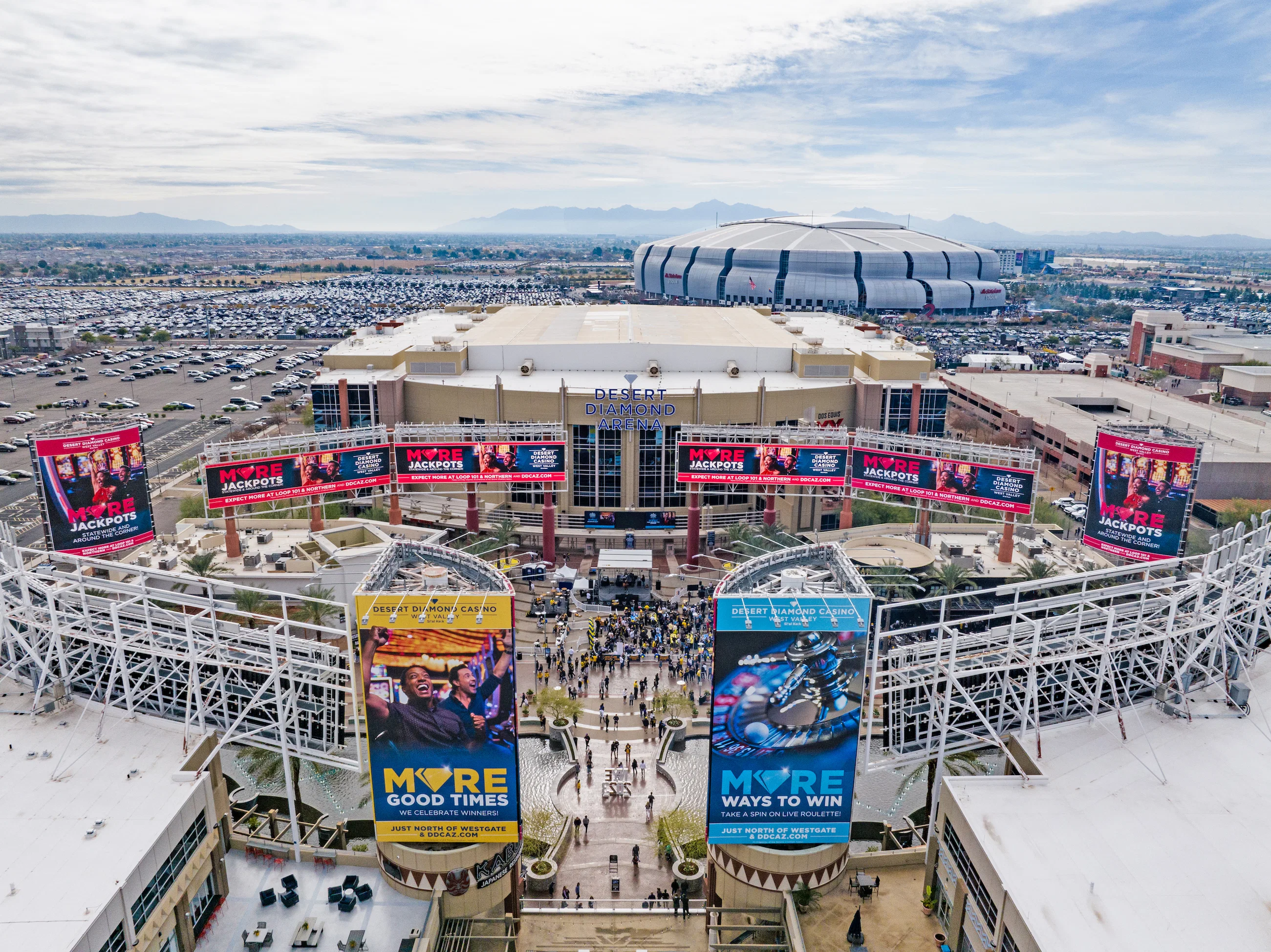
Strong planning covers Desert Diamond Arena as a planning reference for teams coordinating corporate events, sponsor activations, and special programming in the Greater Phoenix market. The project plan should turn venue rules, freight deadlines, labor windows, and exhibitor goals into a workable show schedule.
The arena sits in the Westgate Entertainment District in Glendale, approximately sixteen miles northwest of Tempe along Loop 101 and approximately thirteen miles northwest of downtown Phoenix. Tempe Tourism says the city has more than 7,100 hotel rooms, and Visit Phoenix says the convention-center campus anchors a larger metro ecosystem that includes downtown hotel inventory and major meeting infrastructure.
The arena says it seats approximately 18,000 and hosts concerts, family shows, and special events. Planners coordinating activations, experiential programs, or corporate hospitality at the arena typically anchor lodging in the Westgate corridor, downtown Tempe, or the Old Town Scottsdale hotel cluster depending on attendee origin and post-event programming.
Venue facts to confirm before move-in
- Desert Diamond Arena says it is a multi-purpose arena in the Westgate Entertainment District.
- The arena says it seats approximately 18,000.
- Desert Diamond Arena says it hosts concerts, family shows, and special events.
Planning Context for Desert Diamond Arena
- Loop 101 freight timing between Westgate, Tempe, and Phoenix Sky Harbor International Airport varies sharply by time of day and event schedule, with off-peak runs taking twenty-five to thirty-five minutes and rush-hour windows extending past sixty minutes
- Sits in the Westgate Entertainment District in Glendale with approximately 18,000 seats, which positions it as a corporate-event and activation venue separate from the convention-center and hotel ballroom programs in downtown Phoenix and Tempe
- Lodging clusters include the Westgate corridor, downtown Tempe hotels such as Omni Tempe Hotel at ASU and Tempe Mission Palms, and Old Town Scottsdale properties when VIP or executive programming extends beyond the arena footprint
- Move-in and strike schedules are set by the arena's event calendar and the venue's loading-dock capacity, which means advance coordination with the venue's operations team is required to lock dock time and freight windows
- Jurisdiction for labor, AV, rigging, and other services at Desert Diamond Arena follows the venue's house-services model and any official show contractor assigned to the event, not the exhibitor's origin city or the planner's preferred vendor roster
Venue Footprint and Facility Context
The arena says it is a multi-purpose arena in the Westgate Entertainment District with approximately 18,000 seats. The arena hosts concerts, family shows, and special events year-round. Planners coordinating corporate hospitality, sponsor activations, or experiential programs at the arena need to confirm the event date, available event space, and any concurrent programming that might affect loading-dock access or freight timing before finalizing booth design or service orders.
The Westgate Entertainment District sits along Loop 101 in Glendale, approximately sixteen miles northwest of Tempe and thirteen miles northwest of downtown Phoenix. The district includes restaurants, retail, and hospitality inventory that supports pre-event and post-event programming. Planners routing freight from Phoenix Sky Harbor International Airport, from Tempe warehousing, or from Phoenix Convention Center installations need to confirm Loop 101 traffic windows to avoid late arrivals during rush-hour or event-night congestion.
The arena's loading docks and freight-staging zones are shared across all events on the arena calendar. Move-in and strike windows must be coordinated with the venue's operations team and any official event contractor assigned to the program. Teams assuming dock access based on a standard convention-center schedule often discover that arena dock windows are shorter, more tightly controlled, and dependent on the venue's concurrent event calendar.
- Seats approximately 18,000 and hosts concerts, family shows, and corporate events year-round
- The Westgate Entertainment District sits along Loop 101 in Glendale, approximately sixteen miles northwest of Tempe and thirteen miles northwest of downtown Phoenix
- Loading-dock access and freight-staging zones are shared across all arena events, which means move-in windows must be confirmed with the venue's operations team before finalizing service schedules
- Planners routing freight from Phoenix Sky Harbor International Airport or from Tempe warehousing need to confirm Loop 101 traffic windows to avoid late arrivals during rush-hour or event-night congestion
Freight Routing and Timing Between Glendale, Tempe, and Phoenix
Loop 101 connects the Westgate Entertainment District to Tempe and to Phoenix Sky Harbor International Airport. Off-peak freight runs from the airport to the arena take approximately twenty-five to thirty-five minutes. During morning rush-hour windows between 6:30 AM and 9:30 AM or afternoon rush-hour windows between 3:30 PM and 7:00 PM, the same run can extend past sixty minutes. Planners coordinating tight load-in schedules need to build buffer time into dock appointments and freight-arrival windows to account for traffic variability.
Freight originating from Tempe warehousing or from downtown Phoenix installations follows a similar routing pattern along Loop 101 or along I-10 and Loop 101. Teams consolidating freight at Omni Tempe Hotel at ASU or at Phoenix Convention Center before final delivery to the arena need to confirm that the route does not cross peak traffic windows or conflict with the venue's dock schedule. Missing a dock window at the arena typically means rescheduling for the next available slot, which can push installation timelines into show-day hours or force overnight labor.
Return freight after strike follows the same routing constraints. Planners coordinating same-day return shipments to Tempe warehousing, to Phoenix Sky Harbor International Airport, or to the next show city need to confirm that strike completes before evening rush-hour traffic begins and that dock access is available for pallet staging and truck loading.
- Loop 101 freight runs from Phoenix Sky Harbor International Airport to the Westgate Entertainment District take twenty-five to thirty-five minutes off-peak and can extend past sixty minutes during rush-hour windows
- Freight originating from Tempe warehousing or from Phoenix Convention Center installations must avoid peak traffic windows to meet confirmed dock appointments at Desert Diamond Arena
- Missing a dock window at the arena typically means rescheduling for the next available slot, which can push installation timelines into show-day hours or force overnight labor
- Return freight after strike follows the same routing constraints and requires strike completion before evening rush-hour traffic begins
Lodging Strategy for Arena Events and Corporate Programs
Lodging for arena events depends on attendee origin, program duration, and any post-event programming. Teams coordinating single-day activations or sponsor hospitality often anchor lodging in the Westgate corridor to minimize drive time and simplify ground transportation. Multi-day programs with VIP guests, executive meetings, or conference components typically anchor lodging in downtown Tempe at Omni Tempe Hotel at ASU, Tempe Mission Palms, or The Westin Tempe, or in Old Town Scottsdale at resort properties that support higher-end hospitality programming.
Downtown Tempe hotels offer proximity to Phoenix Sky Harbor International Airport and to the Light Rail system, which connects Tempe to downtown Phoenix and to the Phoenix Convention Center campus. Tempe Tourism says the city has more than 7,100 hotel rooms, and the official 2025 Meeting Planner Guide lists Omni Tempe Hotel at ASU with 330 rooms and 36,000 total square feet of meeting space. Teams coordinating conference sessions, breakout meetings, or VIP dinners alongside arena programming can consolidate these components at a downtown Tempe hotel and shuttle attendees to the Westgate Entertainment District for evening programs.
Old Town Scottsdale lodging supports executive-tier programs and VIP hospitality. The drive from Old Town Scottsdale to the Westgate Entertainment District takes approximately thirty to forty minutes off-peak via Loop 101. Planners coordinating high-touch hospitality or sponsor activations that require resort-level amenities often split lodging between Old Town Scottsdale for VIP guests and the Westgate corridor or downtown Tempe for staff and crew.
- Single-day activations or sponsor hospitality programs often anchor lodging in the Westgate corridor to minimize drive time and simplify ground transportation
- Multi-day programs with VIP guests, executive meetings, or conference components typically anchor lodging in downtown Tempe at Omni Tempe Hotel at ASU, Tempe Mission Palms, or The Westin Tempe, or in Old Town Scottsdale at resort properties
- Downtown Tempe hotels offer proximity to Phoenix Sky Harbor International Airport and to the Light Rail system, which connects Tempe to downtown Phoenix and to the Phoenix Convention Center campus
- Old Town Scottsdale lodging supports executive-tier programs and VIP hospitality, with the drive to the Westgate Entertainment District taking approximately thirty to forty minutes off-peak via Loop 101
Jurisdiction and Service Coordination at Desert Diamond Arena
Jurisdiction for labor, AV, rigging, and other services at the arena follows the venue's house-services model and any official show contractor assigned to the event. Exhibitors and planners arriving from other markets sometimes assume they can appoint their own vendors based on prior relationships or preferred pricing. At the arena, service jurisdiction is controlled by the venue and by the event organizer's official contractor roster, which means planners need to confirm vendor approval and jurisdictional boundaries before issuing service orders.
House services at the arena typically include power distribution, rigging, AV, and labor for event setup and strike. Planners coordinating custom booth builds, specialized lighting, or experiential installations need to confirm which services are exclusive to the house contractor and which services allow third-party vendors. Missing this step often results in last-minute vendor substitutions, delayed installations, or on-site service fees that exceed the original budget.
Advance coordination with the venue's operations team and the official event contractor is required to lock dock time, confirm power distribution, and finalize rigging plans. Teams assuming that arena operations follow the same workflow as Phoenix Convention Center or WestWorld of Scottsdale often discover that the arena has tighter dock windows, stricter rigging permits, and more limited staging zones. Confirming these details three to four weeks before load-in prevents show-floor surprises and ensures that all vendors arrive with the correct permits, credentials, and service orders.
- Jurisdiction for labor, AV, rigging, and other services at Desert Diamond Arena follows the venue's house-services model and any official show contractor assigned to the event
- House services typically include power distribution, rigging, AV, and labor for event setup and strike, with jurisdictional boundaries set by the venue and the event organizer's official contractor roster
- Advance coordination with the venue's operations team and the official event contractor is required to lock dock time, confirm power distribution, and finalize rigging plans
- Teams assuming that arena operations follow the same workflow as Phoenix Convention Center or WestWorld of Scottsdale often discover tighter dock windows, stricter rigging permits, and more limited staging zones
Relationship Between Desert Diamond Arena and the Broader Phoenix Trade-Show Market
The arena sits outside the convention-center core but connects to the broader Phoenix trade-show market through corporate hospitality, sponsor activations, and experiential programs that extend beyond standard expo floors. Visit Phoenix says the convention-center campus anchors a larger metro ecosystem that includes downtown hotel inventory and major meeting infrastructure. Teams coordinating multi-venue programs often combine expo space at Phoenix Convention Center with evening activations or VIP programming at the arena, or they anchor conference sessions at downtown Tempe hotels and host receptions or sponsor events at the arena.
The Westgate Entertainment District offers retail, dining, and entertainment infrastructure that supports pre-event and post-event programming. Planners coordinating sponsor activations, product launches, or consumer-facing events at the arena can extend programming into the district's public spaces, restaurants, and retail zones to maximize attendee engagement and brand visibility. This flexibility makes the arena a useful complement to the convention-center and hotel ballroom programs that dominate the Tempe, Phoenix, and Scottsdale event calendars.
Freight and lodging coordination between the arena and other Phoenix-area venues requires attention to Loop 101 traffic patterns, dock-window conflicts, and hotel-block timing. Teams running concurrent programs at Phoenix Convention Center and the arena need to confirm that freight deliveries, labor schedules, and attendee transportation do not overlap in ways that create bottlenecks or force last-minute service changes. Planners who map these handoffs in advance avoid the service gaps and timing conflicts that derail multi-venue programs.
- Connects to the broader Phoenix trade-show market through corporate hospitality, sponsor activations, and experiential programs that extend beyond standard expo floors
- Teams coordinating multi-venue programs often combine expo space at Phoenix Convention Center with evening activations or VIP programming at the arena, or they anchor conference sessions at downtown Tempe hotels and host receptions or sponsor events at the arena
- The Westgate Entertainment District offers retail, dining, and entertainment infrastructure that supports pre-event and post-event programming and extends sponsor activations beyond the arena footprint
- Freight and lodging coordination between the arena and other Phoenix-area venues requires attention to Loop 101 traffic patterns, dock-window conflicts, and hotel-block timing to avoid service gaps and timing conflicts
Frequently Asked Questions
How long does it take to move freight from Phoenix Sky Harbor International Airport to Desert Diamond Arena?
Off-peak freight runs from Phoenix Sky Harbor International Airport to the Westgate Entertainment District take approximately twenty-five to thirty-five minutes via Loop 101. During morning rush-hour windows between 6:30 AM and 9:30 AM or afternoon rush-hour windows between 3:30 PM and 7:00 PM, the same run can extend past sixty minutes. Planners coordinating tight load-in schedules need to build buffer time into dock appointments to account for traffic variability.
Can I use my preferred vendor for AV, rigging, or labor at this work?
Jurisdiction for labor, AV, rigging, and other services at the arena follows the venue's house-services model and any official show contractor assigned to the event. Service jurisdiction is controlled by the venue and by the event organizer's official contractor roster, which means planners need to confirm vendor approval and jurisdictional boundaries before issuing service orders. Missing this step often results in last-minute vendor substitutions or on-site service fees that exceed the original budget.
Where should I anchor lodging for a corporate event at the program?
Lodging strategy depends on attendee origin, program duration, and any post-event programming. Single-day activations or sponsor hospitality programs often anchor lodging in the Westgate corridor to minimize drive time. Multi-day programs with VIP guests, executive meetings, or conference components typically anchor lodging in downtown Tempe at Omni Tempe Hotel at ASU, Tempe Mission Palms, or The Westin Tempe, or in Old Town Scottsdale at resort properties that support higher-end hospitality programming.
What should I confirm with the venue before finalizing my event schedule?
Planners need to confirm the event date, available event space, and any concurrent programming that might affect loading-dock access or freight timing before finalizing booth design or service orders. Move-in and strike windows must be coordinated with the venue's operations team and any official event contractor assigned to the program. Advance coordination three to four weeks before load-in prevents show-floor surprises and ensures that all vendors arrive with the correct permits, credentials, and service orders.
How does this service fit into the broader Phoenix trade-show market?
The arena sits outside the convention-center core but connects to the broader Phoenix trade-show market through corporate hospitality, sponsor activations, and experiential programs that extend beyond standard expo floors. Teams coordinating multi-venue programs often combine expo space at Phoenix Convention Center with evening activations or VIP programming at the arena, or they anchor conference sessions at downtown Tempe hotels and host receptions or sponsor events at the arena. The Westgate Entertainment District offers retail, dining, and entertainment infrastructure that supports pre-event and post-event programming.