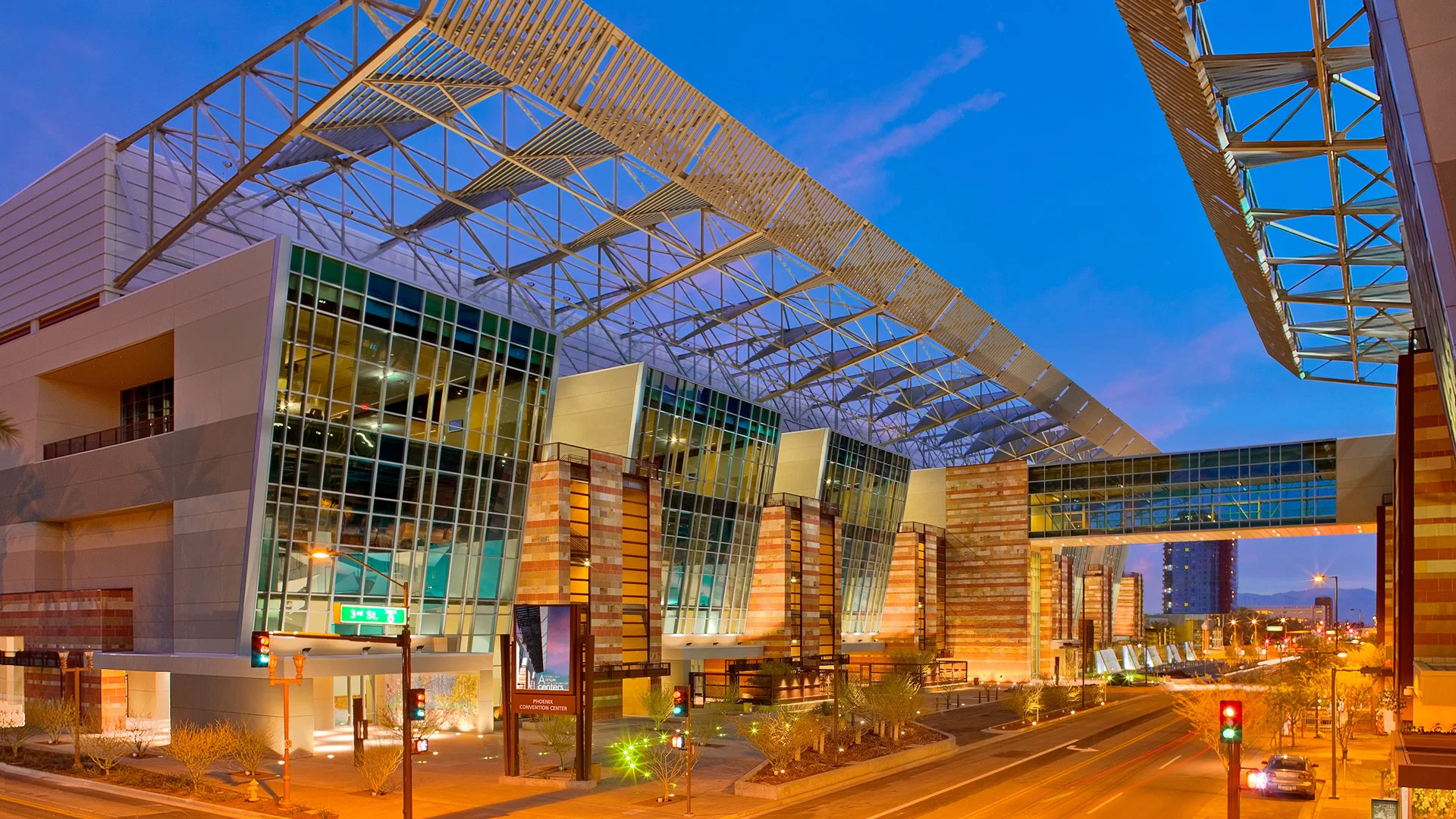
The Phoenix Convention Center (PCC) is the largest single trade show and convention facility in Arizona, and for exhibitors based in or traveling through Tempe, it is the most frequently recurring venue on the calendar. The North Building alone carries 11 exhibit halls, 56 meeting rooms, and 20 climate-controlled loading docks, a scale that drives planning decisions about freight routing, hotel blocks, and booth production timelines weeks before move-in begins.
Tempe-based planners have a geographic relationship with PCC that is both convenient and occasionally complicated. The I-10 corridor connecting Tempe to downtown Phoenix covers roughly six miles, which is a short drive off-peak but can stretch considerably during morning and afternoon rush windows. Show freight arriving from the East Valley or from Phoenix Sky Harbor International Airport (five miles from downtown Tempe) will route through that same corridor, so delivery scheduling requires attention to time-of-day, not simply total distance.
Strong planning covers what a Tempe-area exhibitor or planner needs to understand about PCC before committing to a booth contract: campus layout, the services hierarchy that governs what you can and cannot arrange independently, the hotel geography, and how the venue fits into the broader metro event calendar alongside WestWorld of Scottsdale, Mesa Convention Center, and the Tempe conference hotel cluster.
Venue facts to confirm before move-in
- Visit Phoenix says the interconnected campus includes three ballrooms, 99 meeting and breakout rooms, a 2,300-seat performance hall, and an Executive Conference Center.
- Visit Phoenix says the North Building has 635,000 square feet of meeting and exhibition space, 11 exhibit halls, 56 meeting rooms, and 20 climate-controlled loading docks.
- The official exhibit section says Phoenix Convention Center and Venues uses in-house service partners.
What Tempe-Area Exhibitors Need to Know About PCC
- North Building: 635,000 square feet, 11 exhibit halls, 56 meeting rooms, and 20 climate-controlled loading docks, one of the largest single-building convention footprints in the Southwest
- Campus totals: three ballrooms, 99 meeting and breakout rooms, a 2,300-seat performance hall, and an Executive Conference Center across the full Phoenix Convention Center complex
- PCC uses in-house service partners for utilities and building services; the official show contractor governs most exhibitor-facing labor, with Exhibitor Appointed Contractors permitted under specific credentialing and insurance requirements
- I-10 from Tempe to downtown Phoenix covers roughly six miles; fast off-peak, but freight and shuttle timing to PCC needs to account for the 7 to 9 AM and 4 to 7 PM congestion windows on that corridor
- The downtown Phoenix hotel cluster (Sheraton Phoenix Downtown and nearby full-service properties) serves as the primary room block for PCC shows; Tempe hotels including Omni Tempe Hotel at ASU and Tempe Mission Palms absorb overflow when the downtown block sells out
Campus Layout and Exhibit Hall Capacity
The Phoenix Convention Center is effectively a multi-building campus led by the North Building, which contains the bulk of exhibition space. The 635,000 square feet in that building encompasses 11 exhibit halls that can be subdivided or combined depending on show size. At full utilization, the facility can run simultaneous citywide conventions with distinct freight entrances, registration zones, and concourse separation. Planners exhibiting in one hall should understand early which hall their show occupies, because dock access, move-in sequencing, and shuttle drop-off points vary by hall assignment.
The broader campus adds three ballrooms suited to general sessions or sponsored evening events, 99 meeting and breakout rooms, an Executive Conference Center for smaller hosted programs, and a 2,300-seat performance hall. For exhibitors, the ballroom and breakout inventory matters because it affects overall show density: a convention using those spaces simultaneously with the exhibit halls will generate heavier foot traffic, longer elevator queues, and tighter parking.
The 20 climate-controlled loading docks in the North Building represent a meaningful operational advantage for shows running during Arizona's summer months. Booth materials sensitive to heat (printed graphics, adhesive-backed substrates, electronics) benefit from climate-controlled staging time. That said, dock windows are allocated by the show's general service contractor, not directly by exhibitors, so advance order deadlines matter.
- Confirm your hall assignment before finalizing booth dimensions; hall numbering at PCC does not correspond to a simple sequential layout
- Request the exhibitor services manual as soon as it is released; PCC shows typically publish manuals 60 to 90 days before move-in
- If your show overlaps with a second concurrent event on campus, expect compressed dock availability and plan freight arrival windows conservatively
- The performance hall and ballroom spaces sit on separate building levels from the exhibit floors, so factor that into any pre-show or post-show event logistics
Services Hierarchy: Who Controls What on the Floor
Phoenix Convention Center and Venues operates with in-house service partners handling building utilities, electrical rough-in to booth perimeters, and certain venue infrastructure. The official show contractor, appointed by show management rather than by PCC, governs exhibitor-facing labor: material handling (drayage), booth installation and dismantle supervision, furniture and carpet rental, and the advance freight warehouse program. Exhibitors who want to use vendors outside the official show contractor's scope fall into Exhibitor Appointed Contractor (EAC) territory, which at PCC requires advance notice to show management, proof of insurance, and compliance with any union or jurisdictional rules in the show manual.
The distinction between what PCC controls and what the show contractor controls is not always obvious from the exhibitor kit. Electrical power to booth perimeters often routes through a PCC-affiliated utility provider, while the labor to run cords within your booth may fall to the official show contractor or an approved EAC. When collecting quotes, ask each vendor to specify exactly which scope they are pricing and which entity has jurisdiction over that scope.
Audio-visual and rigging at PCC follow the same general principle: the venue may have a preferred or exclusive AV partner for house-system work, while in-booth AV can go to an EAC with proper credentials. Rigging from the ceiling grid requires advance approval and typically uses a rigging contractor designated by either the venue or the show. This is not a scope exhibitors can self-perform or freely assign.
- The EAC authorization form is typically due 30 days before move-in; missing this deadline can block your chosen vendor from floor access
- Drayage at PCC shows is almost always controlled by the official show contractor; using an outside carrier does not exempt you from handling fees at the dock
- Ceiling rigging approval requires structural drawings in most cases, so start this process well before the exhibitor kit deadline if your booth includes suspended elements
- Electrical ordering through the in-house utility provider should match your booth's load calculations; underordering circuits is one of the most common and costly on-site corrections
Hotel Geography and Room Block Planning
The primary hotel inventory for Phoenix Convention Center shows clusters in downtown Phoenix, with the Sheraton Phoenix Downtown representing one of the largest connected-block options given its proximity to the campus. Hyatt, Marriott, and other full-service properties within walking distance of PCC are typically absorbed first by show management room blocks and sponsor allocations. Tempe-based attendees who book late frequently find downtown blocks sold out and face the choice of paying premium rates on the open market or accepting a longer commute from East Valley hotels.
Tempe's hotel inventory provides legitimate overflow accommodation for PCC shows. Omni Tempe Hotel at ASU offers 330 rooms and 36,000 square feet of meeting space; Tempe Mission Palms and The Westin Tempe add further capacity in the same downtown-Tempe corridor. The I-10 drive from downtown Tempe to PCC is typically under 15 minutes off-peak. Show shuttle routes generally originate from downtown Phoenix hotels, so Tempe guests driving to PCC should account for parking, which near the convention center runs at metered or garage rates and sells down during large shows.
For exhibitors coordinating staff travel, the Sky Harbor proximity to Tempe is a real advantage. Crews flying into Phoenix Sky Harbor International Airport (five miles from downtown Tempe) can reach Tempe accommodations quickly and then commute to PCC. That two-leg routing, airport to Tempe then Tempe to PCC, is often more practical than dealing with downtown Phoenix airport ground transportation and parking during peak show days.
- Book inside the show room block when possible; rates on the open market near PCC during citywide shows routinely exceed block pricing by 30 to 50 percent
- If staying in Tempe, plan the I-10 westbound commute to PCC outside the 7 to 9 AM window; eastbound return in the 4 to 7 PM window is equally congested
- Tempe Mission Palms and Omni Tempe Hotel at ASU both offer meeting space for pre-show team briefings or client dinners without requiring a second trip downtown
- Confirm whether the show offers shuttle service from any Tempe or East Valley hotels; larger citywide conventions occasionally include East Valley pickup points
Freight Routing and Advance Warehouse Logistics
Freight bound for Phoenix Convention Center from the East Valley travels I-10 westbound, a route that covers roughly six miles from the Tempe area to the downtown Phoenix interchange. The practical challenge is time-of-day sensitivity. Trucks and vans caught on that stretch during morning peak can add 20 to 40 minutes to an otherwise short run, which matters when dock windows at PCC are allocated in tight blocks during move-in. Coordinating with your carrier to arrive during assigned windows, not simply on the right day, is the operational discipline that keeps move-in on schedule.
Most PCC shows offer an advance warehouse program through the official show contractor. Freight shipped to the advance warehouse arrives before show move-in begins, which avoids the dock congestion of direct-to-show delivery and allows for earlier quality checks on crates and graphics. The tradeoff is the advance warehouse handling fee on top of the base drayage rate. For exhibitors with complex booths or fragile materials, the added cost is usually worth the reduced on-floor stress. Advance warehouse cutoff dates are published in the exhibitor services manual and are enforced strictly; late freight arriving after the cutoff reverts to direct-to-show routing, often at a higher rate.
Exhibitors shipping from vendors in the Phoenix metro have some flexibility. Booth materials produced locally or regionally can stage near the show without using the advance warehouse at all, provided the carrier holds the freight and delivers during the assigned dock window. Planners should confirm whether this approach is permitted by the show contractor and what documentation is required for dock check-in.
- Request your dock window assignment as early as possible; popular early move-in windows fill quickly on large PCC shows
- I-10 westbound from Tempe to downtown Phoenix: off-peak is typically 10 to 15 minutes; peak can approach 35 to 45 minutes for the same run
- Advance warehouse cutoffs at PCC shows are typically 5 to 7 business days before the first move-in date; calendar this before signing the freight contract
- Empty crate storage at PCC during show days is managed by the official show contractor; label all crates clearly and retain the return tag provided during move-in
PCC in the Valley Event Calendar: What Else Is Competing
Phoenix Convention Center is one venue in a metro event ecosystem that includes WestWorld of Scottsdale, the Arizona State Fairgrounds, and the Mesa Convention Center, each of which draws different show types. WestWorld hosts consumer shows, equestrian events, and expos with large outdoor components. The Arizona State Fairgrounds handles public exhibitions and seasonal events. Mesa Convention Center, with 19,000 square feet of exhibit area and an additional 19,000 square feet of meeting space, serves regional and mid-size conferences that do not require PCC's scale.
For Tempe planners, understanding where any given show lands in that ecosystem determines the logistical complexity. A PCC show competing for downtown hotel rooms on the same dates as a major Scottsdale resort conference creates compounding scarcity in Valley hotel inventory. This is not an abstract concern: the Greater Phoenix Economic Council identifies semiconductors, aerospace and defense, biosciences, and advanced manufacturing as active demand drivers in the metro, and trade shows tied to those industries do overlap on the calendar in ways that affect room availability and vendor bandwidth.
Checking the PCC events calendar well before finalizing exhibit commitments is standard planning practice. Knowing whether your show dates put you adjacent to a sold-out citywide or a quiet midweek conference affects everything from hotel strategy to the availability of local labor and rental inventory. Shows scheduled in January through March face tighter inventory across the board than shows in summer months, as that window is Arizona's peak convention season.
- PCC citywide conventions and WestWorld consumer shows occasionally share the same weekend in the Valley calendar, compressing hotel supply across multiple submarkets simultaneously
- January through March is peak season in the Phoenix metro; freight carriers, labor pools, and hotel rates reflect that demand
- Mesa Convention Center is a useful alternative for regional programs that do not require PCC's scale, and its East Valley location reduces freight routing complexity for Tempe-based exhibitors
- The Greater Phoenix Economic Council's industry concentration in biosciences and aerospace-defense means related industry shows recur in this market annually, so building vendor relationships here has compounding value over multiple show cycles
Phoenix Convention Center — Frequently Asked Questions
How far is Phoenix Convention Center from Tempe, and what is the realistic drive time?
The Phoenix Convention Center sits roughly six miles northwest of downtown Tempe via I-10 westbound. Off-peak, that drive runs 10 to 15 minutes. During the morning window (7 to 9 AM) or the afternoon peak (4 to 7 PM), the same run can take 30 to 45 minutes. For show days with early floor access or late strike windows, planning around those congestion periods makes a material difference in crew arrival times and freight coordination.
Can Tempe exhibitors use vendors outside the official show contractor at PCC?
Yes, but the process requires advance coordination. Exhibitor Appointed Contractors (EACs) are permitted at most PCC shows, subject to show management approval, proof of insurance, and compliance with any jurisdictional or union rules specified in the show manual. The EAC authorization form is typically due 30 days before move-in; missing that deadline often results in the vendor being denied floor access. Building services (utilities, electrical rough-in, rigging) may be subject to in-house or exclusive arrangements that fall outside EAC latitude, so verify scope line by line before assuming any vendor is eligible.
What are the hotel options near PCC, and when should a Tempe-based team book?
Downtown Phoenix hotels adjacent to PCC, including the Sheraton Phoenix Downtown and full-service Hyatt and Marriott properties nearby, are the closest options and are usually allocated through show management room blocks first. For citywide shows, those blocks can sell out months before the event. Tempe hotels including Omni Tempe Hotel at ASU and Tempe Mission Palms serve as practical overflow, with I-10 access making the commute manageable off-peak. Booking within the show block as early as registration opens is the surest way to avoid open-market premium pricing during peak Valley convention weeks.
How does the advance warehouse program work for PCC shows?
Most PCC shows offer an advance warehouse program administered by the official show contractor. Freight shipped to the advance warehouse before the cutoff date (typically 5 to 7 business days before first move-in) avoids direct dock congestion and allows earlier inspection of materials. The cost includes both the advance warehouse handling fee and standard drayage to the floor. Freight arriving after the cutoff reverts to direct-to-show routing, often at a higher rate and with less flexibility on dock timing. Planners coordinating multiple shipments from different vendors should align all cutoff dates through the official exhibitor kit to avoid split handling.
How does PCC compare to WestWorld of Scottsdale or Mesa Convention Center for trade show planning purposes?
These venues serve different market segments and rarely compete directly for the same shows. PCC handles large citywide conventions and expos requiring substantial exhibit hall footprint, with the North Building's 635,000 square feet accommodating shows that no other Valley venue can match in scale. WestWorld of Scottsdale is the primary option for consumer shows, equestrian events, and outdoor-adjacent expos; its Equidome and Monterra spaces suit formats that PCC's enclosed halls do not. Mesa Convention Center, with 19,000 square feet of exhibit area, is sized for regional conferences and mid-market trade shows. Tempe-based planners who work across multiple show formats may encounter all three venues in a single calendar year, and each has distinct freight routing, labor, and hotel-block logistics.