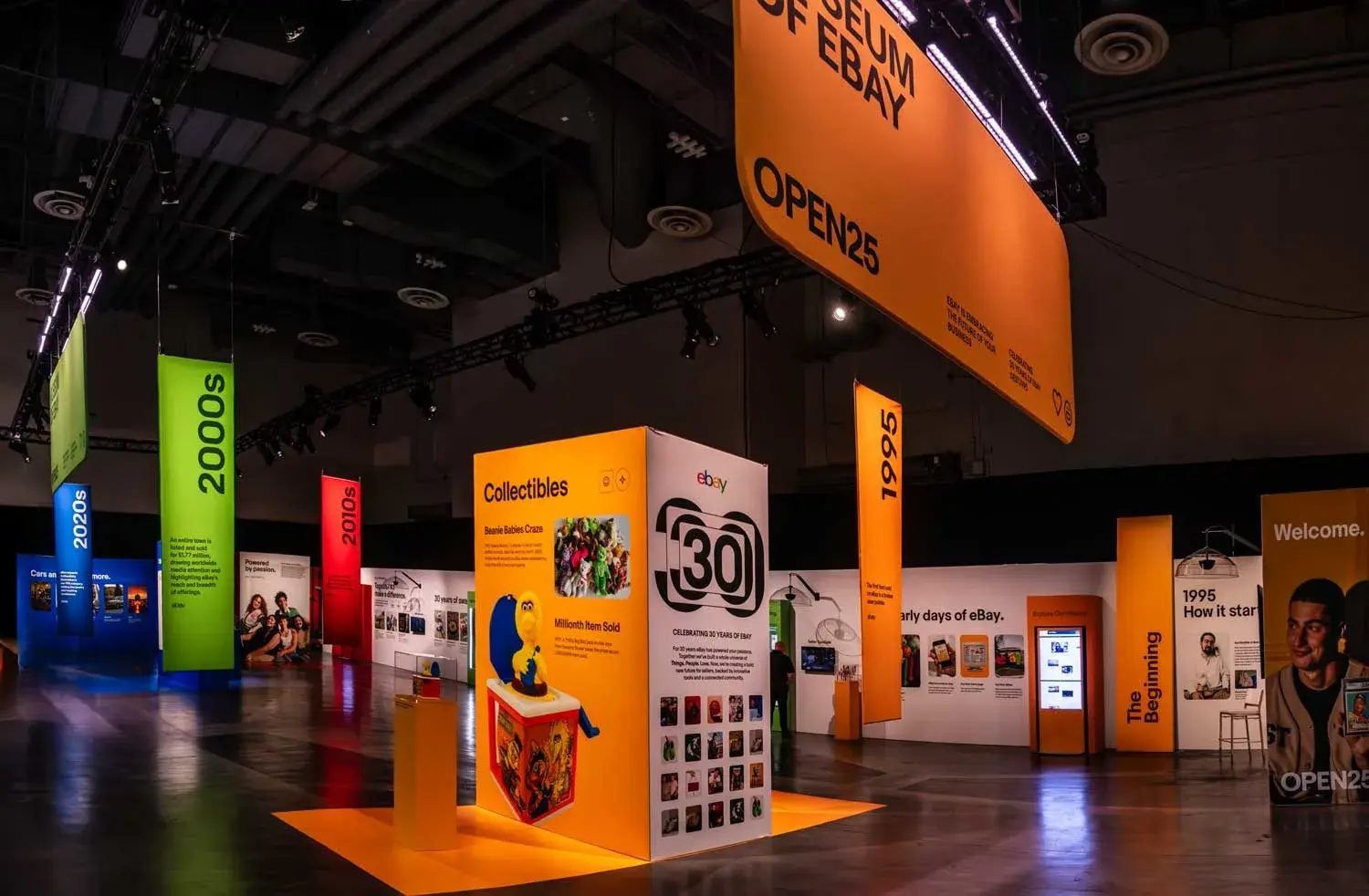
Refurbishment extends the working life of a booth asset by replacing worn panels, updating graphics, reconfiguring footprint, or swapping modular components to match a new show layout. The process is tactical rather than conceptual: an existing structure is evaluated for structural integrity, component interchangeability, and graphic substrate condition before any refurbishment scope is written. Teams exhibiting at Phoenix Convention Center, WestWorld of Scottsdale, or Talking Stick Resort typically start planning refurbishment six to eight weeks before the show if the work involves new graphics, structural modifications, or reconfigurations that change the booth footprint or flow.
Most refurbishment projects involve a combination of graphic refresh, panel replacement, and minor reconfiguration to adapt an existing booth to a different show footprint or brand update. Structural integrity checks confirm that frame members, attachment hardware, and load-bearing components remain serviceable; worn or damaged components get flagged for replacement rather than cosmetic repair. Graphics are evaluated for substrate condition, color accuracy, and mounting compatibility because even a simple graphic swap can expose incompatible mounting systems or reveal that the original panel surface no longer accepts the adhesive or tension system the new graphic requires.
Refurbishment differs from a new build in that the timeline is constrained by the existing asset's availability, condition, and location. If the booth is stored in a remote warehouse or was last used at a show in another state, freight timing and asset retrieval become part of the critical path. Teams working in the Phoenix metro typically coordinate storage at or near Phoenix Sky Harbor International Airport to keep retrieval time predictable; booths stored farther than thirty miles from the airport or from the venue campus add at least one extra day to the freight window and increase the risk of last-minute scope changes if damage is discovered during unloading.
Refurbishment and Reconfiguration Planning Points
- Asset evaluation timeline begins six to eight weeks before the show if the refurbishment includes structural modifications, graphic updates, or reconfiguration; shorter windows apply only to simple graphic swaps on modular systems with verified compatibility
- Structural integrity checks identify frame damage, worn attachment hardware, and load-bearing component fatigue before any refurbishment scope is finalized; cosmetic fixes do not address underlying structural problems
- Graphic substrate condition determines whether new graphics can be mounted on existing panels or whether panel replacement is required; adhesive compatibility, tension-system requirements, and surface preparation time are all part of the assessment
- Freight timing between storage location and venue campus affects the refurbishment schedule; booths stored farther than thirty miles from Phoenix Sky Harbor or the venue cluster add at least one extra day to the retrieval and inspection window
- Reconfiguration scope includes footprint changes, component repositioning, and modular system reassembly; every reconfiguration requires updated floor plans, electrical and AV load maps, and rigging or suspension reviews if the new layout changes structural loading patterns
Asset Evaluation and Structural Integrity
Asset evaluation begins with a documented inspection of frame members, attachment hardware, graphic panels, flooring, and any integrated AV, lighting, or rigging components. Structural integrity checks focus on fatigue, corrosion, deformation, and connection-point wear because these issues determine whether the booth can be refurbished or whether key components require replacement. Teams exhibiting at Phoenix Convention Center or WestWorld of Scottsdale typically perform this evaluation at the storage location rather than waiting until load-in; discovering frame damage or incompatible mounting hardware at the venue compresses the response window.
Frame members are inspected for cracks, bends, and fastener pull-through. Graphic panels are evaluated for substrate delamination, surface damage, and mounting-system compatibility; if the original panel used a hook-and-loop mounting system and the new graphic requires tension fabric or rigid-panel clips, the panel substrate may need replacement even if the surface appears intact. Flooring sections are checked for edge damage, surface wear, and interlocking-system function.
- Frame members and attachment hardware are inspected for fatigue, corrosion, and connection-point wear at the storage location before the refurbishment scope is finalized; field discoveries of structural damage compress response time and increase cost
- Graphic panel substrate condition determines whether new graphics can be mounted on existing panels or whether panel replacement is required; adhesive compatibility and mounting-system changes often force panel replacement even when the surface appears serviceable
- Integrated AV, lighting, and rigging components are tested for functionality and code compliance; older fixtures and cable runs may no longer meet current venue electrical or fire-safety standards, and reconfiguration can change loading patterns even if total weight remains constant
- Flooring sections are checked for edge damage, surface wear, and interlocking-system function; carpet tiles, laminate panels, and raised-floor systems have finite working lives and refurbishment is the replacement point rather than the patch point
Graphic Refresh and Substrate Compatibility
Graphic refresh involves more than swapping printed panels; it requires substrate compatibility assessment, mounting-system verification, and surface preparation because new graphics often use different materials or attachment methods than the original installation. Teams exhibiting at Talking Stick Resort, Omni Tempe Hotel at ASU, or The Westin Tempe for hotel ballroom programs face tighter timelines than convention-center exhibitors because hotel venue access windows are shorter and load-in schedules are less forgiving of last-minute graphic issues.
Substrate compatibility includes adhesive requirements, tension-fabric frame fit, and rigid-panel attachment-point alignment. Hook-and-loop systems, silicone-edge graphics, magnetic mounts, and clip-rail systems all have specific substrate requirements; switching from one system to another during a refurbishment may require panel replacement or frame modification. Surface preparation time is a hidden variable because panels that have been in storage often accumulate dust, adhesive residue, or surface contamination that prevents clean graphic adhesion.
- Substrate compatibility assessment includes adhesive requirements, tension-fabric frame fit, and rigid-panel attachment-point alignment; switching mounting systems during refurbishment often requires panel replacement or frame modification
- Surface preparation time accounts for dust, adhesive residue, and contamination on panels that have been stored or used at multiple shows; cleaning and prep work add time to the installation schedule and must be included in the load-in plan
- Color accuracy and finish durability are critical because refurbished booths are often placed next to new builds; mixing graphic technologies creates visual inconsistency and increases the risk of uneven fading or delamination over time
Reconfiguration Planning and Footprint Changes
Reconfiguration changes the booth layout, footprint, or internal flow by repositioning modular components, adding or removing panels, or adjusting the structural frame to fit a new show space. Every reconfiguration requires updated floor plans, electrical and AV load maps, and rigging or suspension reviews because even minor changes to component placement can affect structural loading, egress paths, and venue code compliance. Teams exhibiting at Phoenix Convention Center, WestWorld of Scottsdale, or Mesa Convention Center coordinate reconfigurations with the official show contractor and venue services team to confirm that the new layout meets aisle width, fire-egress, and sight-line requirements before load-in begins.
Footprint changes are constrained by the modular system's design limitations and by the availability of compatible components. A ten-by-twenty inline booth cannot be reconfigured into a twenty-by-twenty island without additional frame members, corner posts, and structural bracing. Component interchangeability is a function of the original system's design; proprietary extrusion systems, custom panel sizes, and non-standard attachment hardware all limit the ability to repurpose components in a new configuration.
- Updated floor plans, electrical and AV load maps, and rigging reviews are required for every reconfiguration because component repositioning affects structural loading, egress paths, and code compliance; venue services and the official show contractor must approve the new layout before load-in
- Footprint changes are constrained by modular system design limitations and component availability; proprietary extrusion systems, custom panel sizes, and non-standard attachment hardware all limit repurposing options
- Assembly-sequence planning accounts for installation and dismantle complexity introduced by reconfiguration; dry-fit sessions at the production facility or warehouse identify fit issues before the booth arrives at the venue and prevent time-sensitive workflow disruptions during load-in
- Modular systems have specific footprint ranges; converting an inline booth into an island configuration often requires additional frame members, corner posts, and structural bracing that are not part of the original asset inventory
Production Lead Time and Freight Coordination
Production lead time for refurbishment projects is determined by the scope of work, component availability, and the production facility's current queue. Graphic production alone can take two to three weeks if new graphics require custom printing, color matching, or substrate procurement. Teams exhibiting at Phoenix Convention Center or the Arizona State Fairgrounds typically initiate refurbishment planning six to eight weeks before the show to allow time for asset evaluation, scope finalization, production, and freight coordination.
Freight coordination includes asset retrieval from storage, transport to the production facility for refurbishment work, and final delivery to the venue. If the booth is stored near Phoenix Sky Harbor or within the Tempe, Mesa, or Scottsdale hotel clusters, retrieval and transport timing is predictable; booths stored farther than thirty miles from the airport or venue campus add travel time and increase the risk that transport delays compress the production window.
- Graphic production takes two to three weeks if new graphics require custom printing, color matching, or substrate procurement; structural modifications and panel replacements add time for material sourcing, dimensional verification, and component integration
- Component availability is a constraint for booths using proprietary hardware, discontinued panel sizes, or custom extrusion profiles; some systems maintain backward compatibility while others require custom fabrication if original components are unavailable
- Freight coordination includes asset retrieval from storage, transport to the production facility, and final delivery to the venue; booths stored farther than thirty miles from Phoenix Sky Harbor or the venue campus add travel time and increase the risk of transport delays compressing the production window
Cost Estimation and Scope Documentation
Cost estimation for refurbishment is more variable than for a new build because the condition of the existing asset introduces unknowns that only become visible during the evaluation phase. Teams exhibiting in the Phoenix metro request itemized quotes that separate graphic production, structural work, component replacement, labor, and freight so that scope changes during the evaluation phase can be assessed without renegotiating the entire project.
Scope documentation includes a detailed asset-condition report, a list of components being retained versus replaced, and a clear definition of what work will be performed at the production facility versus what will be handled during load-in. Clear scope documentation prevents disputes about what was included in the original quote and what constitutes a change order. Hotel ballroom programs at Omni Tempe Hotel at ASU, Tempe Mission Palms, or The Westin Tempe often carry higher labor rates and tighter access windows than convention-center shows.
- Itemized quotes separate graphic production, structural work, component replacement, labor, and freight so that scope changes during asset evaluation can be assessed without renegotiating the entire project
- Scope documentation includes a detailed asset-condition report, a list of retained versus replaced components, and a clear definition of work performed at the production facility versus on-site during load-in; this prevents disputes about included work and change orders
- Venue-specific costs include labor rates, access-window constraints, and fees for rigging, electrical, or AV integration; hotel ballroom programs often carry higher labor rates and tighter setup windows than convention-center shows, and these costs must be itemized in the budget
- Refurbishment projects with reconfiguration or footprint changes require updated rigging plans, electrical load calculations, and AV integration work; all of these tasks carry labor and material costs that must be accounted for to avoid budget overruns
Booth Refurbishment and Reconfiguration Questions
How far in advance should refurbishment planning begin for a show at Phoenix Convention Center?
Refurbishment planning should begin six to eight weeks before the show if the project includes graphic updates, structural modifications, or reconfiguration. Shorter timelines apply only to simple graphic swaps on modular systems with verified substrate compatibility and no structural changes. Starting earlier allows time for asset evaluation, component sourcing, production, and freight coordination without compressing the load-in schedule.
What happens if structural damage is discovered during the asset evaluation?
Structural damage identified during evaluation must be addressed before the refurbishment scope is finalized. Frame members, attachment hardware, and load-bearing components that show fatigue, corrosion, or deformation are flagged for replacement rather than cosmetic repair. Discovering damage at the venue during load-in compresses the response window and increases cost, so evaluation at the storage location is standard practice.
Can any modular booth be reconfigured into a different footprint?
Reconfiguration is constrained by the modular system's design limitations and component availability. Systems are designed for specific footprint ranges; converting an inline booth into an island configuration often requires additional frame members, corner posts, and structural bracing. Proprietary extrusion systems, custom panel sizes, and discontinued hardware all limit reconfiguration options, and some changes require custom fabrication rather than simple component repositioning.
How does graphic substrate compatibility affect refurbishment timelines?
Substrate compatibility determines whether new graphics can be mounted on existing panels or whether panel replacement is required. Hook-and-loop, silicone-edge, magnetic, and clip-rail systems all have specific substrate requirements, and switching systems during refurbishment may force panel replacement or frame modification. Incompatible substrates discovered during load-in create workflow bottlenecks that delay booth setup.
What freight considerations apply to booths stored outside the Phoenix metro?
Booths stored farther than thirty miles from Phoenix Sky Harbor or the venue campus add at least one extra day to the retrieval and inspection window. Freight timing includes asset retrieval, transport to the production facility for refurbishment, and final delivery to the venue. Remote storage increases the risk of transport delays compressing the production window and increases the likelihood of discovering damage during unloading rather than during the initial evaluation.