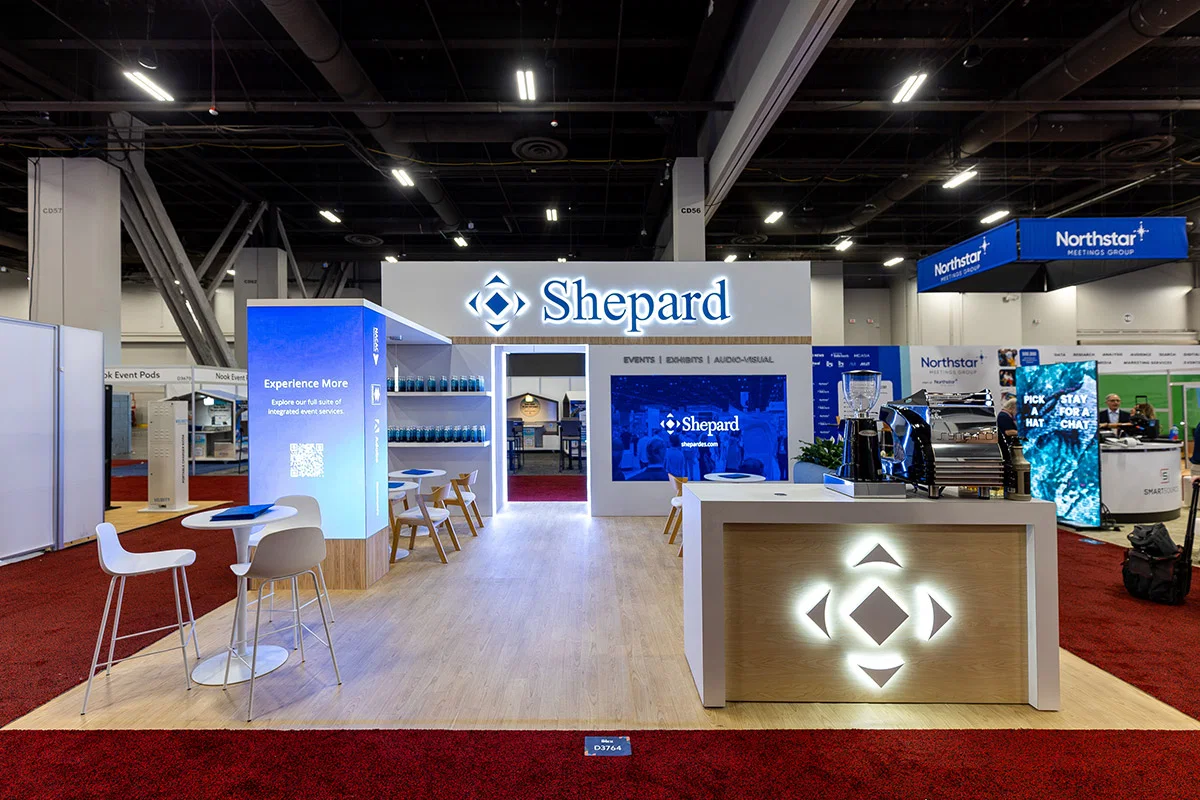
Modular booths use pre-engineered frames, fabric or panel infills, and tool-free connectors that let a crew assemble on-site without custom fabrication. Exhibitors working Phoenix Convention Center shows, WestWorld consumer expos, or Arizona State Fairgrounds track modular systems because the booth ships in rolling cases, clears loading docks quickly, and scales from a 10×10 inline to a 20×20 island without redesigning the exhibit.
A typical 10×10 modular booth ships in three to five rolling cases weighing 50 to 80 pounds each, while a 20×20 island arrives in eight to twelve cases. The frame components nest flat, graphics roll or fold, and hardware packs into labeled compartments. Freight companies route these shipments via standard LTL carriers, and the lighter weight keeps dimensional charges lower than custom exhibits built with millwork or heavy substrates.
The planning sequence starts with footprint confirmation, then moves to graphic production, advance service orders, and dock scheduling. The exhibitor confirms booth size with the show organizer, orders electrical and internet from the official contractor, submits graphic files to the vendor, and arranges freight pickup at least two weeks before the advance warehouse deadline. The install crew receives the cases, confirms the asset count, assembles the frame, attaches graphics, and installs accessories.
Modular Booth Planning for Tempe-Area Trade Shows
- Freight case count and weight for shipments into Phoenix Convention Center, WestWorld, and Mesa Convention Center docks, with typical 10×10 booths arriving in three to five cases under 400 pounds total
- Reconfiguration flexibility that lets a 10×10 inline booth expand to a 20×20 island or a 10×20 peninsula using the same frame inventory and updated graphics, reducing capital expense for multi-show exhibitors
- On-site assembly time and labor requirements at venues with union jurisdiction and EAC-friendly rules, where tool-free connectors and pre-cut components keep installation within a four-hour window for most inline configurations
- Graphic production lead times for tension-fabric panels, SEG frames, and direct-print hard substrates, with most Tempe-area vendors requiring two to three weeks for initial orders and five to seven business days for reprints
- Advance service orders for electrical, internet, and rigging at Phoenix Convention Center and WestWorld, where modular booths typically draw 5 to 20 amps and require standard floor-drop or overhead-conduit routing
Footprint and Freight
Modular frames align with 10-foot increments, and connectors lock at 90-degree or 45-degree angles. A 10×10 inline booth uses four vertical posts and horizontal beams, while a 20×20 island adds corner towers and overhead canopies. Frame components ship flat because extrusions nest and connectors pack separately, so freight companies charge less for a flat-pack system than a crated custom exhibit occupying the same floor space.
Phoenix Convention Center, WestWorld, and Mesa Convention Center operate docks with height restrictions and time windows that favor rolling cases over palletized crates. A 10×10 modular booth in four cases clears the dock in a single cart load, while a custom exhibit requiring a forklift adds dock time and labor fees. Exhibitors coordinating freight along Interstate 10 or Interstate 17 schedule delivery during the advance warehouse window, which opens four to seven days before move-in and closes 48 hours before the first install shift.
Dock crews at Phoenix Convention Center and WestWorld scan incoming freight against the exhibitor's booth number and the official contractor's manifest. A modular booth shipping in five cases needs five matching labels with the same booth number, exhibitor name, and case count. Missing cases trigger a search that delays the install crew. The exhibitor or EAC project manager reconciles the asset count before assembly starts.
- 10×10 modular booths ship in three to five rolling cases totaling 250 to 400 pounds, while 20×20 island configurations arrive in eight to twelve cases ranging from 600 to 900 pounds
- Flat-pack frame systems reduce dimensional-weight charges on LTL freight routes into Phoenix Sky Harbor or direct to venue docks at Phoenix Convention Center and WestWorld
- Advance warehouse windows at Phoenix Convention Center typically open four days before move-in and close 48 hours prior, with direct-to-floor freight incurring drayage surcharges of $80 to $150 per hundred-weight
Frame Assembly and Install Workflow
Modular systems use tool-free connectors that lock posts to beams without hex keys or drills. The crew unpacks components, assembles the base grid on the floor, raises the vertical posts, locks the top beams, and attaches stabilizers. Tension-fabric graphics slide over the frame and zip along the bottom edge, while SEG panels insert into routed channels with silicone gaskets. Hard-substrate panels mount with clips or magnets.
Install labor at Phoenix Convention Center and WestWorld follows the official contractor's rules or the exhibitor's EAC agreement. A 10×10 inline booth assembled by a two-person EAC crew finishes in two to three hours, including unpacking, frame assembly, graphic attachment, and accessory installation. A 20×20 island booth with overhead rigging and multiple monitors takes four to six hours and may require coordination with the contractor's electrical team and the venue's rigging supervisor.
- Tool-free connectors reduce on-site assembly time to two to three hours for 10×10 inline booths and four to six hours for 20×20 island configurations with overhead rigging
- Union jurisdiction at Phoenix Convention Center applies to booths exceeding the square-footage threshold or requiring house-services electrical and rigging support, with EAC crews handling smaller footprints under the official show contractor's guidelines
- Strike and repack workflow ensures frame components, connectors, and graphics return to the labeled cases in the correct sequence, preventing lost parts and simplifying the next install at WestWorld or Mesa Convention Center
Graphic Production and Lead Times
Modular booths accept tension fabric, SEG panels, direct-print rigid substrates, and vinyl appliques. Tension-fabric graphics stretch over the frame and attach with zippers or hook-and-loop fasteners. The fabric prints with dye-sublimation, producing busy color and fine detail. SEG panels use silicone-edge gaskets that insert into routed channels, creating a smooth appearance without visible fasteners.
Graphic vendors serving Tempe and Phoenix markets require two to three weeks for initial orders. Rush orders compress the timeline to five to seven business days but add surcharges of 25 to 50 percent. Exhibitors coordinating graphics for Phoenix Convention Center or WestWorld submit design files in the correct format, confirm the color profile matches the print method, and verify panel dimensions align with the frame specifications.
- Tension-fabric graphics require two to three weeks for initial orders and five to seven business days for rush reprints, with dye-sublimation printing producing the color saturation and detail exhibitors expect at Phoenix Convention Center shows
- SEG panels insert into routed frame channels with silicone gaskets, creating a smooth edge-to-edge appearance that works well for large-format branding at WestWorld consumer expos and Arizona State Fairgrounds public shows
- Graphic file specifications must match the modular frame's panel dimensions and the print vendor's color profile to avoid misfit panels and color shifts that delay the install or require last-minute corrections
Reconfiguration and Multi-Show Use
Modular systems reconfigure, so an exhibitor can use the same frame inventory for a 10×10 inline booth at one show and a 20×20 island at the next by adding components and updating graphics. The frame extrusions, connectors, and base plates remain the same, and the exhibitor orders additional posts, beams, and canopy supports to expand the footprint.
Reconfiguration planning starts with the booth layout and show-floor assignment. The exhibitor confirms the available footprint with the show organizer, sketches the new configuration, updates the graphic panels, orders additional frame parts, and schedules the install crew. The cost to reconfigure a 10×10 booth into a 20×20 island typically ranges from $3,000 to $8,000, depending on new frame components, graphic reprint scope, and expanded install labor.
- Reconfiguration cost to expand a 10×10 inline booth into a 20×20 island ranges from $3,000 to $8,000, including new frame components, updated graphics, and expanded install labor at Phoenix Convention Center or WestWorld
- Multi-show exhibitors use the same modular frame inventory across three to four events per year, reducing capital expense and simplifying freight coordination between Tempe-area venues and out-of-state convention centers
- Booth layout changes require updated graphic panels that match the new configuration, with most Tempe-area print vendors offering file-storage services that simplify reorders and ensure color consistency across multiple print runs
Advance Service Orders and Venue Coordination
Modular booths at Phoenix Convention Center, WestWorld, and Mesa Convention Center require advance service orders for electrical, internet, rigging, and furniture rental. The official contractor or house-services team provides these services, and the exhibitor places orders through the online portal during the advance-order window. A 10×10 modular booth with LED lighting and a monitor typically draws 5 amps, while a 20×20 island with multiple screens and overhead lighting may require 20 amps or a dedicated circuit.
Internet service at Phoenix Convention Center and WestWorld routes through the official contractor's network, which charges by bandwidth tier and connection type. A wired ethernet drop costs less than wireless service and provides more reliable speeds for lead-capture software and cloud-based demos. The contractor's technician installs the drop on the first day of move-in, and the exhibitor or EAC crew tests the connection before the show opens.
Rigging orders apply when the modular booth includes overhead canopies, hanging signs, or monitor arms that exceed the venue's weight limits. Phoenix Convention Center's rigging department reviews the booth drawing, confirms attachment points, and schedules the install crew. The exhibitor submits the rigging request during the advance-order window with engineering drawings, weight calculations, and insurance certificate.
- Electrical orders for modular booths at Phoenix Convention Center and WestWorld typically range from 5 amps for a 10×10 inline booth to 20 amps for a 20×20 island configuration, with dedicated circuits required for high-draw equipment exceeding 15 amps
- Wired ethernet drops cost less than wireless service and provide stable bandwidth for lead-capture software and cloud-based demos, with advance orders closing 10 to 14 days before show-floor move-in at most Tempe-area venues
- Overhead rigging at Phoenix Convention Center requires engineering drawings, weight calculations, and insurance certificates submitted during the advance-order window, with late requests subject to availability and surcharges
Modular Trade Show Booth Questions
What is the typical freight weight for a 10×10 modular booth shipping into Phoenix Convention Center?
A 10×10 modular booth typically ships in three to five rolling cases totaling 250 to 400 pounds. The frame components nest flat, the graphics roll or fold, and the hardware packs into labeled compartments, which keeps the dimensional weight lower than a crated custom exhibit occupying the same floor space.
How long does it take to assemble a modular booth at WestWorld of Scottsdale?
A two-person EAC crew assembles a 10×10 inline modular booth in two to three hours, including case unpacking, frame assembly, graphic attachment, and accessory installation. A 20×20 island configuration with overhead rigging and multiple monitors takes four to six hours and may require coordination with the official contractor's electrical and rigging teams.
Can a 10×10 modular booth reconfigure into a 20×20 island for a different show?
Yes, modular systems are designed to reconfigure by adding frame components and updating the graphics. The exhibitor orders additional posts, beams, and canopy supports to expand the footprint and prints new graphic panels that match the larger layout. The cost to reconfigure typically ranges from $3,000 to $8,000, depending on the component count and the graphic reprint scope.
What graphic formats work with modular booth frames at Tempe-area venues?
Modular booths accept tension fabric, SEG panels, direct-print rigid substrates, and vinyl appliques. Tension fabric stretches over the frame and attaches with zippers or hook-and-loop fasteners, while SEG panels insert into routed channels with silicone gaskets. Most Tempe-area graphic vendors require two to three weeks for initial orders and five to seven business days for rush reprints.
Do modular booths require union labor at Phoenix Convention Center?
Union jurisdiction at Phoenix Convention Center applies to booths exceeding the square-footage threshold or requiring house-services electrical and rigging support. EAC crews handle smaller modular booths under the official show contractor's guidelines. A 10×10 inline booth assembled by the exhibitor or the EAC team typically does not trigger union jurisdiction, while a 20×20 island booth with overhead rigging may require union labor coordination.