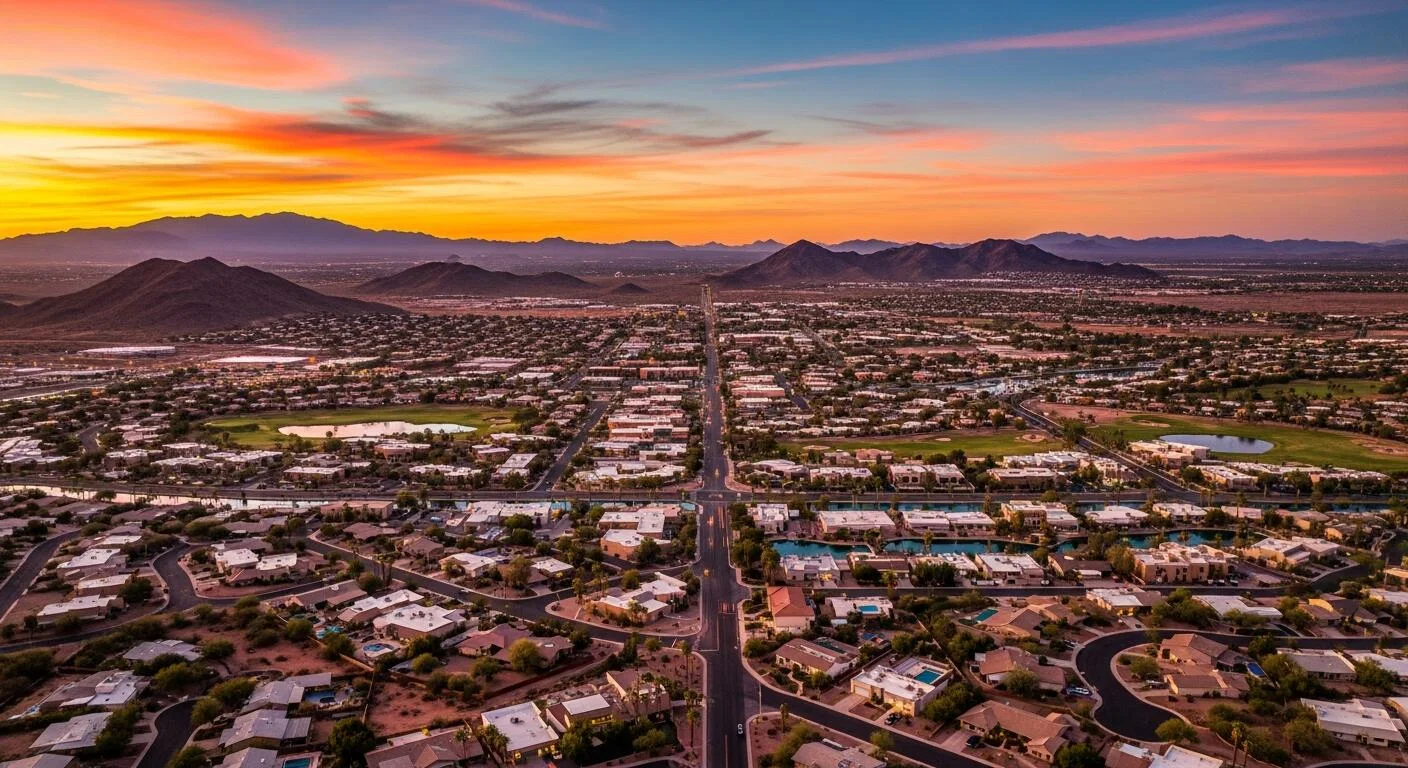
Strong planning covers trade-show planning context for West Chandler. The project plan should turn venue rules, freight deadlines, labor windows, and exhibitor goals into a workable show schedule. The operating framework is the Southeast Valley corridor between Phoenix Convention Center, Omni Tempe Hotel at ASU, and Mesa Convention Center.
West Chandler planning connects to three venue clusters. Phoenix Convention Center sits roughly fourteen miles northwest via I-10 with 635,000 square feet of meeting and exhibition space and 20 climate-controlled loading docks. Omni Tempe Hotel at ASU sits approximately seven miles north via Loop 202 with 330 rooms and 36,000 square feet of meeting space. Mesa Convention Center sits about twelve miles east with 19,000 square feet of exhibit area and another 19,000 square feet of meeting space.
The planning sequence is origin freight routing along I-10 or Loop 202, hotel blocks along the Tempe-Chandler corridor or at the venue campus, and labor jurisdiction tied to the venue rather than the crew origin. Planners working West Chandler-origin teams need advance notice for freight timing, parking or lodging at the actual venue campus, and service deadlines from the official show contractor or house team.
Planning Anchors for West Chandler Teams
- I-10 westbound freight timing between West Chandler and Phoenix Convention Center avoids the 6:30–9:00 AM and 3:30–7:00 PM windows; outside them the run is roughly twenty minutes, inside them it can stretch beyond fifty
- Loop 202 northbound between West Chandler and Downtown Tempe hotel inventory runs twelve to eighteen minutes off-peak and up to forty minutes during peak weekday windows
- Phoenix Convention Center anchors the largest Valley convention program with 11 exhibit halls, 56 meeting rooms, and a 2,300-seat performance hall in the interconnected campus
- Omni Tempe Hotel at ASU provides Downtown Tempe conference capacity seven miles north along Loop 202 with ballroom and breakout inventory suitable for mid-size corporate programs
- Labor jurisdiction follows the venue contract, not the crew origin city; house services and official show contractor coverage apply whether the install team drives from West Chandler, Tempe, or Phoenix
West Chandler Geography and Venue Access
West Chandler sits where Chandler's business corridor meets Loop 202 and I-10 access to Tempe and Phoenix. The primary event venues are Phoenix Convention Center fourteen miles northwest, Omni Tempe Hotel at ASU seven miles north, and Mesa Convention Center twelve miles east. Visit Phoenix says the convention-center campus includes three ballrooms, 99 meeting and breakout rooms, and an Executive Conference Center. Tempe Tourism lists Omni Tempe Hotel at ASU with 330 rooms and seven meeting rooms. Visit Mesa describes Mesa Convention Center as a full-service downtown facility offering 19,000 square feet of exhibit area and an additional 19,000 square feet of meeting space.
West Chandler teams planning exhibit programs typically route freight along I-10 westbound to Phoenix Convention Center or Loop 202 northbound to Tempe hotel inventory. Off-peak I-10 runs fourteen miles in roughly twenty minutes; peak windows between 6:30–9:00 AM and 3:30–7:00 PM can stretch that to fifty minutes or more. Loop 202 northbound to Downtown Tempe runs twelve to eighteen minutes off-peak and up to forty minutes during weekday rush windows. Planners need to account for these timing variations when scheduling dock appointments, advance delivery windows, or load-in access.
Hotel block strategy depends on the venue and the event footprint. Phoenix Convention Center programs often anchor lodging at Sheraton Phoenix Downtown or other downtown inventory within walking distance of the campus. Tempe programs use Omni Tempe Hotel at ASU, Tempe Mission Palms, or The Westin Tempe along the Mill Avenue corridor. Mesa programs rely on downtown Mesa hotel inventory near the convention center. West Chandler does not host major convention inventory itself; teams working out of West Chandler coordinate logistics to the actual venue location.
- I-10 westbound from West Chandler to Phoenix Convention Center runs fourteen miles; off-peak timing is roughly twenty minutes, peak windows can exceed fifty minutes
- Loop 202 northbound from West Chandler to Downtown Tempe runs seven miles; off-peak twelve to eighteen minutes, peak windows up to forty minutes
- Phoenix Convention Center offers 635,000 square feet of meeting and exhibition space, 11 exhibit halls, 56 meeting rooms, and 20 climate-controlled loading docks
- Omni Tempe Hotel at ASU provides 330 rooms and 36,000 total square feet of meeting space along the Downtown Tempe corridor
Freight Routing and Timing from West Chandler
Freight origin in West Chandler requires routing along I-10 westbound to Phoenix or Loop 202 northbound to Tempe. Phoenix Convention Center programs use I-10 westbound with dock access off Jefferson Street and Third Street. Visit Phoenix says the North Building has 20 climate-controlled loading docks. Peak-hour I-10 congestion between 6:30–9:00 AM and 3:30–7:00 PM can add thirty to forty minutes to the fourteen-mile run, so planners typically schedule dock appointments outside those windows or allow extra buffer time for late arrivals.
Tempe hotel programs route freight along Loop 202 northbound to Mill Avenue and University Drive exits. Omni Tempe Hotel at ASU, Tempe Mission Palms, and The Westin Tempe all sit within the Downtown Tempe corridor. Hotel loading docks do not operate on the same scale as convention-center docks; advance notice for large case counts, oversized crates, or extended unload windows is standard. Tempe Tourism says the city has 28-plus miles of rail and streetcar access, but freight routing still relies on truck access rather than transit infrastructure.
Mesa Convention Center programs route freight along Loop 202 eastbound to Dobson Road and Main Street. Visit Mesa describes Mesa Convention Center as a downtown facility with 19,000 square feet of exhibit area. Dock capacity and unload windows are smaller than Phoenix Convention Center, so planners need to verify advance delivery options, storage availability, and target-the-floor timing with the venue or official show contractor before committing to a move-in schedule.
- I-10 westbound carries Phoenix Convention Center freight; dock access is off Jefferson Street and Third Street with 20 climate-controlled bays
- Loop 202 northbound routes Tempe hotel freight to Mill Avenue and University Drive exits; hotel docks require advance notice for large deliveries
- Loop 202 eastbound carries Mesa Convention Center freight; Dobson Road and Main Street exits serve the downtown facility
- Peak-hour congestion on I-10 and Loop 202 adds thirty to forty minutes to standard off-peak runs; planners schedule dock appointments outside 6:30–9:00 AM and 3:30–7:00 PM windows
Labor Jurisdiction and Service Workflow
Labor jurisdiction follows the venue contract, not the crew origin. Phoenix Convention Center operates under house services and official show contractor rules. Visit Phoenix describes the interconnected campus with specific house services for rigging, electrical, and utilities. Teams working Phoenix Convention Center programs coordinate with the official show contractor for labor, material handling, and installation support regardless of whether the booth ships from West Chandler, Tempe, or another Valley location.
Tempe hotel programs follow hotel-specific service rules. Omni Tempe Hotel at ASU, Tempe Mission Palms, and The Westin Tempe each manage house services for audio-visual, catering, and event support. Exhibitor Appointed Contractors can typically install booth graphics, rental furniture, and AV setups within the ballroom footprint, but venue coordination is required for anything involving rigging points, ceiling suspension, or electrical distribution beyond standard outlet access. Tempe Tourism lists 140,000 square feet of meeting space across the city's hotel and venue inventory, but jurisdiction rules vary by property.
Mesa Convention Center operates its own house services and official show contractor framework. Visit Mesa positions the center as a full-service meeting and event facility with 38,000 total square feet of combined exhibit and meeting space. Planners need to verify labor jurisdiction, advance order deadlines, and material handling rates before committing to a budget. West Chandler teams do not change the jurisdiction or service workflow; the venue contract defines those parameters.
- Phoenix Convention Center labor jurisdiction is managed by house services and the official show contractor, regardless of crew origin city
- Tempe hotel programs follow property-specific house services for AV, catering, and event support; Exhibitor Appointed Contractors coordinate booth install within ballroom footprint
- Mesa Convention Center operates its own house services and official show contractor framework; advance order deadlines and labor rates are venue-specific
- Labor jurisdiction is tied to the venue contract, not to whether the install team drives from West Chandler, Tempe, or Phoenix
Hotel Blocks and Lodging Strategy
Phoenix Convention Center programs anchor hotel blocks at Sheraton Phoenix Downtown and other downtown inventory within walking distance of the campus. Visit Phoenix describes the convention-center campus as an interconnected system with connected hotel access. Large citywide conventions often reserve hundreds of rooms across multiple downtown properties; planners typically commit room blocks six to twelve months before the event date to secure inventory and avoid peak-season rate spikes.
Tempe hotel programs use Omni Tempe Hotel at ASU, Tempe Mission Palms, The Westin Tempe, Canopy by Hilton Tempe Downtown, DoubleTree by Hilton Phoenix Tempe, and Embassy Suites by Hilton Phoenix Tempe. Tempe Tourism lists 7,100-plus hotel rooms across the city's inventory. Downtown Tempe properties sit within one to two miles of each other along the Mill Avenue and Rio Salado Parkway corridors. Teams working corporate conferences or mid-size trade shows often consolidate lodging at one or two anchor hotels rather than spreading room blocks across multiple properties.
Mesa Convention Center programs rely on downtown Mesa hotel inventory near the convention center. Visit Mesa describes the center as located downtown with nearby lodging support. West Chandler teams working Mesa programs need to verify hotel availability, block minimums, and attrition clauses before signing contracts. Tempe and Phoenix hotel inventory can serve as overflow if downtown Mesa capacity is constrained, but drive times and shuttle logistics add complexity to the event plan.
- Phoenix Convention Center room blocks anchor at Sheraton Phoenix Downtown and other downtown properties within walking distance of the campus
- Tempe hotel inventory includes Omni Tempe Hotel at ASU, Tempe Mission Palms, The Westin Tempe, and other properties along the Mill Avenue corridor; 7,100-plus total rooms across the city
- Mesa Convention Center programs use downtown Mesa hotel inventory near the convention center; overflow can route to Tempe or Phoenix with shuttle logistics
- Room block commitments six to twelve months in advance secure inventory and avoid peak-season rate spikes for citywide conventions
Planning Context for West Chandler Origin Teams
West Chandler planning context is origin freight routing, hotel logistics at the actual venue, and service deadlines tied to the venue contract. Phoenix Convention Center programs require I-10 westbound freight routing, downtown Phoenix hotel blocks, and coordination with the official show contractor for labor and material handling. Tempe hotel programs require Loop 202 northbound freight routing, Downtown Tempe lodging, and property-specific house services coordination. Mesa Convention Center programs require Loop 202 eastbound freight routing, downtown Mesa hotel inventory, and venue-specific advance order deadlines.
The planning sequence starts with venue selection, event dates, and booth footprint confirmation. Once those anchors are locked, the planner works backward to freight timing, hotel block commitments, and service vendor coordination. West Chandler origin does not change the venue workflow; it simply defines the freight origin and the drive-time math for dock appointments and arrival windows. Planners need to account for I-10 and Loop 202 peak-hour congestion when scheduling load-in timing and crew arrival.
Greater Phoenix Economic Council identifies Semiconductors, Software, Aerospace and Defense, Biosciences, Healthcare Innovation, Advanced Manufacturing, Data Centers, E-Commerce Distribution and Logistics, Autonomous and Electric Vehicles, and Climate Technology as demand drivers in the metro. West Chandler sits within the Southeast Valley technology and manufacturing corridor. Corporate event demand from these industries supports the broader trade-show and conference market across Phoenix Convention Center, Tempe hotel programs, WestWorld of Scottsdale, and Mesa Convention Center. Planners working West Chandler-origin teams coordinate logistics across this multi-venue metro framework.
- West Chandler planning sequence is venue selection, event dates, booth footprint, then freight timing, hotel blocks, and service vendor coordination
- Phoenix Convention Center programs route freight via I-10 westbound, anchor lodging downtown, and coordinate labor through the official show contractor
- Tempe hotel programs route freight via Loop 202 northbound, use Downtown Tempe lodging, and coordinate house services with the property
- Greater Phoenix Economic Council lists Semiconductors, Software, Aerospace and Defense, and other technology verticals as metro demand drivers; West Chandler sits within the Southeast Valley corporate corridor
Trade Show Planning Questions for West Chandler Teams
How long does freight take from West Chandler to Phoenix Convention Center?
I-10 westbound runs fourteen miles from West Chandler to Phoenix Convention Center. Off-peak timing is roughly twenty minutes. Peak windows between 6:30–9:00 AM and 3:30–7:00 PM can stretch that to fifty minutes or more. Planners schedule dock appointments outside peak windows or add buffer time for late arrivals.
What hotel inventory supports Tempe conference programs from West Chandler?
Tempe hotel inventory includes Omni Tempe Hotel at ASU with 330 rooms and 36,000 square feet of meeting space, Tempe Mission Palms, The Westin Tempe, Canopy by Hilton Tempe Downtown, DoubleTree by Hilton Phoenix Tempe, and Embassy Suites by Hilton Phoenix Tempe. Tempe Tourism lists 7,100-plus total rooms across the city. These properties sit along the Mill Avenue and Rio Salado Parkway corridors within one to two miles of each other.
Does labor jurisdiction change if the install team drives from West Chandler?
No. Labor jurisdiction follows the venue contract, not the crew origin. Phoenix Convention Center, Tempe hotels, and Mesa Convention Center each operate under house services and official show contractor rules. The venue contract defines labor jurisdiction, material handling rates, and advance order deadlines regardless of whether the install team originates in West Chandler, Tempe, or Phoenix.
What is the freight route from West Chandler to Mesa Convention Center?
Loop 202 eastbound carries freight from West Chandler to Mesa Convention Center. The run is approximately twelve miles via Dobson Road and Main Street exits. Off-peak timing is fifteen to twenty minutes. Peak windows can add twenty to thirty minutes. Visit Mesa describes the center as a downtown facility with 19,000 square feet of exhibit area and 19,000 square feet of meeting space.
What are the primary venue options for West Chandler exhibitors in the Valley?
The primary venue options are Phoenix Convention Center with 635,000 square feet of meeting and exhibition space, Omni Tempe Hotel at ASU with 36,000 square feet of meeting space, and Mesa Convention Center with 38,000 total square feet of combined exhibit and meeting space. Additional venue options include WestWorld of Scottsdale for consumer shows and equestrian events, Talking Stick Resort for conference hospitality, and Arizona State Fairgrounds for public shows. West Chandler does not host major convention inventory; teams coordinate logistics to the actual venue location.