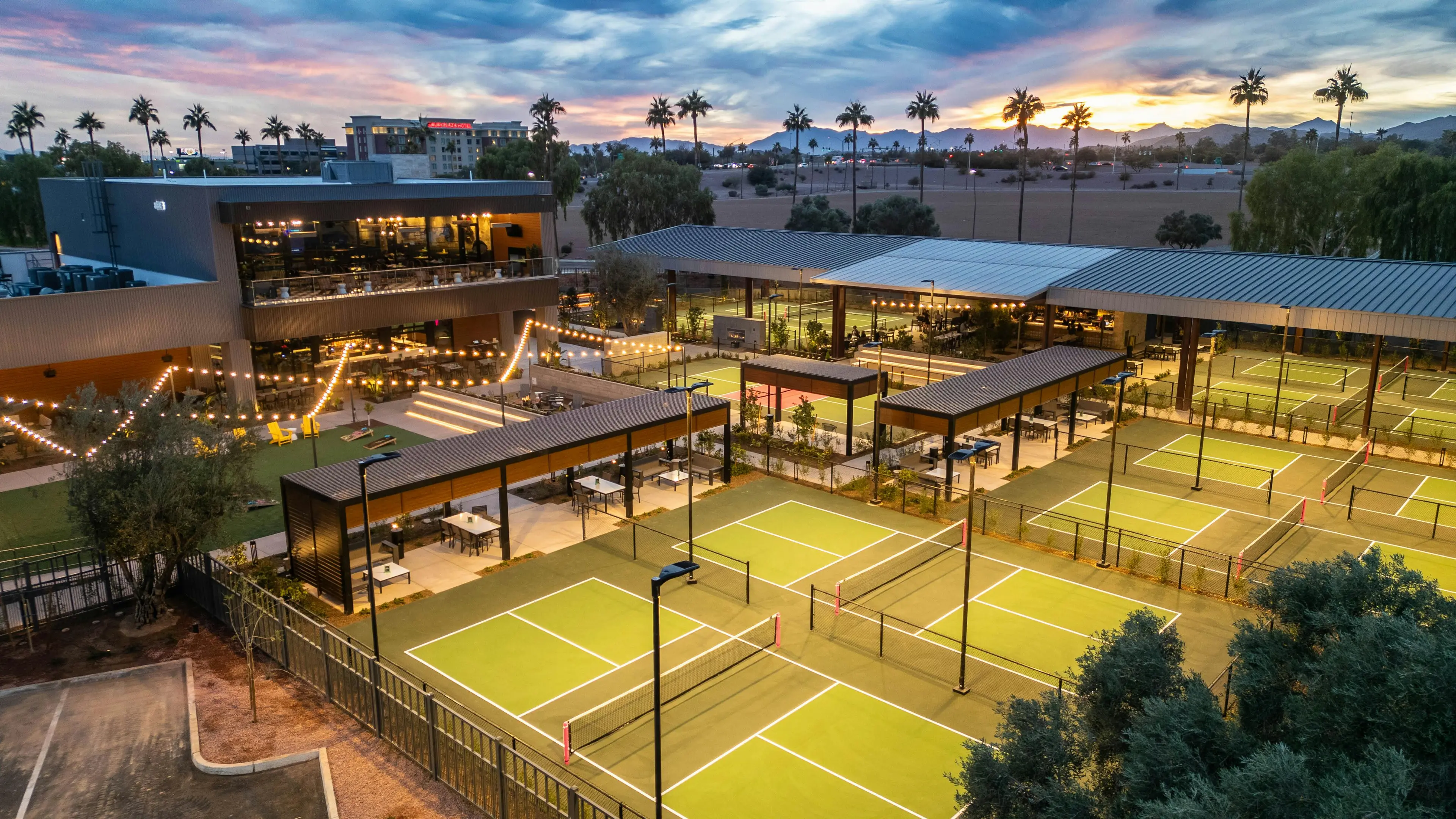
Strong planning covers Electric Pickle as an experiential activation and networking venue in the Downtown Tempe district. The project plan should turn venue rules, freight deadlines, labor windows, and exhibitor goals into a workable show schedule. The venue appears in the official Tempe Tourism meetings inventory with two meeting rooms, 180 seated capacity in standard configuration, and buyout capacity reaching 1,000 standing with 500 seated. That scale and flexibility make it relevant for teams planning receptions, brand activations, and after-hours programs around conferences or expos in the broader Phoenix metro.
The pickle sits within the ASU-adjacent hotel and nightlife corridor, walking distance from Omni Tempe Hotel at ASU, Tempe Mission Palms, and The Westin Tempe. That cluster creates a natural after-hours extension for conferences held at those hotels or at larger venues like Phoenix Convention Center, which sits about nine miles northwest along I-10, or WestWorld of Scottsdale, roughly seventeen miles northeast via Loop 101. Planners treating Downtown Tempe as a social-event satellite for larger convention-center programs use this venue because it supports full buyouts, requires no exhibit logistics, and offers brand-friendly interior flexibility.
The venue fits programs that need a distinct experiential tone rather than traditional ballroom presentation. Sponsor activations, VIP receptions, product-launch parties, and informal networking sessions run here when the event calendar requires separation from the primary show floor. Because the pickle is not a convention facility and does not host exhibit installations, freight planning stays minimal and scheduling runs around social programming rather than load-in deadlines. Teams coordinating multi-venue programs across Tempe and Phoenix treat this as the after-hours anchor, not a daytime meeting space.
Venue facts to confirm before move-in
- Tempe Tourism lists Electric Pickle at 180 seats and two meeting rooms.
- The same official meetings guide says buyout capacity reaches up to 1,000 people with seating for 500.
- Tempe Tourism includes Electric Pickle in the active unique-venue inventory for the Tempe meetings market.
Electric Pickle Planning Focus
- Buyout capacity reaches 1,000 standing and 500 seated, which supports mid-scale sponsor activations and networking receptions without the overhead of a hotel ballroom or convention hall
- Downtown Tempe location within the ASU-adjacent hotel corridor means attendees walk from Omni Tempe Hotel at ASU, Tempe Mission Palms, and The Westin Tempe without ground transport
- Two meeting rooms and flexible interior layout allow brand teams to section programming or run concurrent sponsor zones during multi-track conference after-hours events
- Venue appears in the official Tempe Tourism meetings inventory as an experiential activation space, which signals it is a recognized option for planners coordinating official conference social programs
- No exhibit logistics, no dock requirements, and no union jurisdiction questions simplify planning for teams that need branded environment control without the freight and setup complexity of convention-floor activations
Venue Layout and Capacity Constraints
The pickle operates with 180 seated capacity in standard configuration and expands to 1,000 standing or 500 seated during full buyouts. That range gives planners three distinct programming modes: seated dinner at 180, mixed reception at 500, or full standing networking at 1,000. The two meeting rooms inside allow segmentation when programming needs sponsor zones separated from open networking or when concurrent brand activations share the same buyout window.
Capacity numbers suggest a single-floor layout with connected zones rather than isolated ballroom halls. That open-plan format works well for experiential activations that require sightlines across sponsor stations, but it limits acoustic separation if programming needs simultaneous presentations. Teams coordinating multi-sponsor buyouts typically assign zones by noise level or by attendee flow pattern rather than by rigid room divisions.
Access and load-in remains straightforward because the venue operates as a hospitality space. There are no loading docks, no rigging points, and no dedicated freight elevator, which means setup crews bring materials through front-of-house entry points and stage equipment on-site the same day or the evening before. That simplicity reduces planning overhead but also limits what can be installed.
- Standard seated capacity at 180 means formal dinners, panel discussions, and VIP presentations fit without overcrowding but cannot scale beyond that threshold without shifting to cocktail format
- Full buyout at 1,000 standing or 500 seated supports most after-hours reception programs tied to conferences in the 500–2,000 attendee range, assuming typical 30–50 percent after-hours participation rates
- Two meeting rooms inside the venue allow segmentation when sponsors require separate zones or when programming runs concurrent brand activations during the same buyout window
- No loading docks or freight elevator means setup crews bring materials through front-of-house entry, which simplifies logistics but limits scenic scale and AV complexity compared to hotel ballroom or exhibit-hall installations
Geographic Context and Hotel Proximity
The pickle sits in Downtown Tempe within walking distance of Omni Tempe Hotel at ASU, Tempe Mission Palms, and The Westin Tempe. Conference attendees staying at those hotels walk to the venue without shuttle transport. The ASU-adjacent corridor also includes Canopy by Hilton Tempe Downtown, DoubleTree by Hilton Phoenix Tempe, and Embassy Suites by Hilton Phoenix Tempe, all within a mile radius. Teams booking the pickle for after-hours events typically cluster room blocks across those hotels to keep walk times under fifteen minutes.
Phoenix Convention Center sits about nine miles northwest along I-10. Drive time runs fifteen to twenty minutes outside of peak traffic windows and stretches past thirty minutes during weekday evening rush. Most planners treating Phoenix Convention Center as the primary venue use downtown Phoenix hospitality for after-hours programs, but teams with attendee room blocks in Tempe route their evening programming to the pickle instead. That split-venue strategy works when the conference program ends by 5:00 PM and after-hours events start at 7:00 PM or later.
WestWorld of Scottsdale sits roughly seventeen miles northeast via Loop 101. Teams exhibiting at WestWorld typically hold after-hours events within Scottsdale, but programs with Tempe hotel blocks sometimes route receptions to the pickle. Drive time runs twenty-five to thirty-five minutes depending on traffic, so this routing only makes sense when most attendees are already based in Tempe.
- Walking distance from Omni Tempe Hotel at ASU, Tempe Mission Palms, The Westin Tempe, Canopy by Hilton Tempe Downtown, DoubleTree by Hilton Phoenix Tempe, and Embassy Suites by Hilton Phoenix Tempe means attendees reach the venue in under fifteen minutes without shuttle coordination
- Phoenix Convention Center sits nine miles northwest along I-10, which makes Electric Pickle a secondary after-hours option for exhibitors and conference attendees with Tempe room blocks rather than downtown Phoenix lodging
- WestWorld of Scottsdale sits seventeen miles northeast via Loop 101, and teams exhibiting there sometimes route after-hours programming to Electric Pickle when attendee room blocks are clustered in Tempe instead of North Scottsdale
- Split-venue strategy between primary convention space and Electric Pickle after-hours works when the conference program ends by 5:00 PM and reception start times are set for 7:00 PM or later, giving attendees time to return to Tempe hotels
Programming Fit and Experiential Activation Use
The pickle appears in the Tempe Tourism meetings guide as an experiential activation venue, designed for brand-forward social programming rather than traditional conference breakout sessions. Sponsor activations, product launches, VIP receptions, and informal networking sessions fit better than keynote presentations or seated dinners beyond the 180-seat threshold. The venue's nightlife-adjacent positioning and flexible layout support immersive brand experiences and casual attendee engagement.
Teams coordinating multi-sponsor buyouts use the pickle when the event calendar requires distinct experiential separation from the primary show environment. A technology conference at Phoenix Convention Center might run exhibit-floor demos during the day and route sponsor activations to the pickle in the evening. That separation allows sponsors to control branding and hospitality flow without competing with official show contractor exhibit rules or convention-center house policies.
The venue does not suit programs requiring formal AV production, tiered seating, or presentation stages because it lacks dedicated rigging infrastructure and ballroom-style technical support. Teams planning keynote-style sponsor presentations typically choose hotel ballrooms instead. The pickle works when the program emphasizes attendee interaction and social networking over structured content delivery.
- Experiential activation focus means the venue fits brand-forward sponsor events, product launches, VIP receptions, and informal networking better than keynote presentations, panel discussions, or formal seated dinners beyond the 180-seat threshold
- Multi-sponsor buyouts work when sponsors want distinct experiential separation from the primary convention exhibit floor or conference ballroom environment, allowing independent branding and hospitality flow without house-contractor jurisdiction
- Venue positioning and flexible layout support immersive brand experiences, interactive sponsor zones, and casual attendee engagement that would feel forced in a traditional hotel ballroom or out of place on a convention show floor
- Programs requiring formal AV production, tiered seating, or presentation stages typically choose hotel ballrooms instead because Electric Pickle lacks dedicated rigging infrastructure, sound isolation, and ballroom-style technical support
Logistics and Service Coordination
The pickle operates as a hospitality venue, which means service coordination follows restaurant-and-bar catering logic instead of official-show-contractor jurisdiction. Planners coordinate food, beverage, AV, and décor through the venue's internal team or through external vendors approved by the venue. That simplicity reduces planning overhead but also means teams cannot rely on convention-industry service templates.
Setup timing typically runs the day of the event or the evening before. Because there are no loading docks or dedicated freight elevators, setup crews bring materials through front-of-house entry points without the multi-day advance warehouse windows common at convention centers. Most sponsor activations complete setup in four to six hours on the day of the event, assuming modest AV, minimal scenic elements, and straightforward branded signage.
Teardown and load-out happen immediately after the event ends, usually the same evening or early the next morning. Unlike convention exhibit programs that allow multi-day teardown windows, the pickle operates on hospitality turnover schedules because the venue may host other bookings the following day. That constraint favors modular setups, rental furniture, and temporary branding over custom-built structures.
- Service coordination follows restaurant-and-bar catering logic rather than official-show-contractor jurisdiction, which means planners negotiate food, beverage, AV, and décor directly with the venue or through venue-approved external vendors
- Setup timing typically runs the day of the event or the evening before, with most sponsor activations completing setup in four to six hours assuming modest AV, minimal scenic elements, and straightforward branded signage
- No loading docks or dedicated freight elevators means setup crews bring materials through front-of-house entry points, which simplifies logistics but limits the scale and complexity of scenic and AV installations compared to hotel ballroom or exhibit-hall setups
- Teardown and load-out happen immediately after the event ends, usually the same evening or early the next morning, because the venue operates on hospitality turnover schedules rather than multi-day convention exhibit teardown windows
Broader Metro Event-Calendar Relationships
The pickle sits within the larger Phoenix metro event ecosystem, which includes Phoenix Convention Center, WestWorld of Scottsdale, Mesa Convention Center, Arizona State Fairgrounds, and dozens of hotel ballroom programs across Tempe, Phoenix, Scottsdale, and Mesa. That ecosystem creates a multi-venue planning environment where after-hours activations, sponsor events, and VIP receptions often land at venues like the pickle while daytime exhibit and conference programming happens at convention centers or hotel conference campuses. Teams coordinating metro-wide programs treat Downtown Tempe as a social-event satellite because of its hotel density, ASU adjacency, and nightlife-adjacent venue inventory.
The venue's position in the Tempe Tourism meetings inventory signals it is part of the official meetings-and-conventions infrastructure rather than an ad-hoc nightlife booking. That designation matters for planners coordinating with destination marketing organizations, hotel sales teams, and regional convention bureaus because it means the venue is recognized as a legitimate option for official conference after-hours programming. Most planners discover the pickle through the Tempe Tourism meetings guide or through referrals from hotel sales teams managing conference room blocks at Omni Tempe Hotel at ASU, Tempe Mission Palms, or The Westin Tempe.
The venue competes with hotel ballrooms like those at Omni Tempe Hotel at ASU, Talking Stick Resort, and Phoenix Convention Center's adjacent hotel properties for after-hours sponsor budgets. The pickle wins bookings when sponsors want experiential differentiation, brand-forward design flexibility, or a nightlife-adjacent tone that hotel ballrooms cannot deliver. Hotel ballrooms win when programs require formal AV production, seated dinner service, or when room-block agreements include bundled event-space pricing. Understanding that competitive dynamic helps planners allocate after-hours budgets correctly and match venue choice to sponsor expectations rather than defaulting to the closest available ballroom.
- Sits within the larger Phoenix metro event ecosystem alongside Phoenix Convention Center, WestWorld of Scottsdale, Mesa Convention Center, and Arizona State Fairgrounds, with Downtown Tempe functioning as a social-event satellite for daytime convention and exhibit programming
- Venue's inclusion in the Tempe Tourism meetings inventory signals it is part of the official meetings-and-conventions infrastructure, which matters for planners coordinating with destination marketing organizations and hotel sales teams managing conference room blocks
- Most planners discover Electric Pickle through the Tempe Tourism meetings guide or through referrals from hotel sales teams at Omni Tempe Hotel at ASU, Tempe Mission Palms, or The Westin Tempe during conference room-block negotiations
- Venue competes with hotel ballrooms for after-hours sponsor budgets and wins bookings when sponsors want experiential differentiation, brand-forward design flexibility, or a nightlife-adjacent tone that traditional hotel ballrooms cannot deliver
Electric Pickle FAQ
What is the maximum capacity at Electric Pickle for a standing reception?
Buyout capacity reaches 1,000 standing or 500 seated according to the Tempe Tourism meetings guide. Most after-hours receptions run in the 300–600 range with a mix of seated VIP zones and standing general-admission areas. Capacity depends on floor-plan layout, bar placement, and whether sponsor activations require dedicated zones.
Can this work handle multi-sponsor activations during the same buyout?
Yes, the venue has two meeting rooms and a flexible interior layout that allows segmentation for concurrent sponsor zones. Teams coordinating multi-sponsor buyouts assign zones by noise level, attendee flow pattern, or sponsor branding requirements. Acoustic separation is limited because the venue operates with an open-plan format rather than isolated ballroom halls.
How far is the program from Phoenix Convention Center?
About nine miles northwest along I-10, which runs fifteen to twenty minutes outside of peak traffic windows and stretches past thirty minutes during weekday evening rush. Most planners treating Phoenix Convention Center as the primary venue use downtown Phoenix hospitality for after-hours programs, but teams with Tempe room blocks sometimes route evening programming to the pickle instead.
Does this service have loading docks or freight elevators?
No, the venue operates as a hospitality space rather than an exhibit hall. Setup crews bring materials through front-of-house entry points and stage equipment on-site the same day or the evening before. That simplicity reduces planning overhead but limits the scale of scenic elements, AV rigs, and fabricated structures compared to hotel ballroom or convention-hall installations.
What is the teardown timeline after an event at the plan?
Teardown and load-out happen immediately after the event ends, usually the same evening or early the next morning. Unlike convention exhibit programs that allow multi-day teardown windows, the pickle operates on hospitality turnover schedules because the venue may host other bookings the following day. Teams need to plan for compressed timelines when selecting fabricated elements, AV rentals, and décor installations.