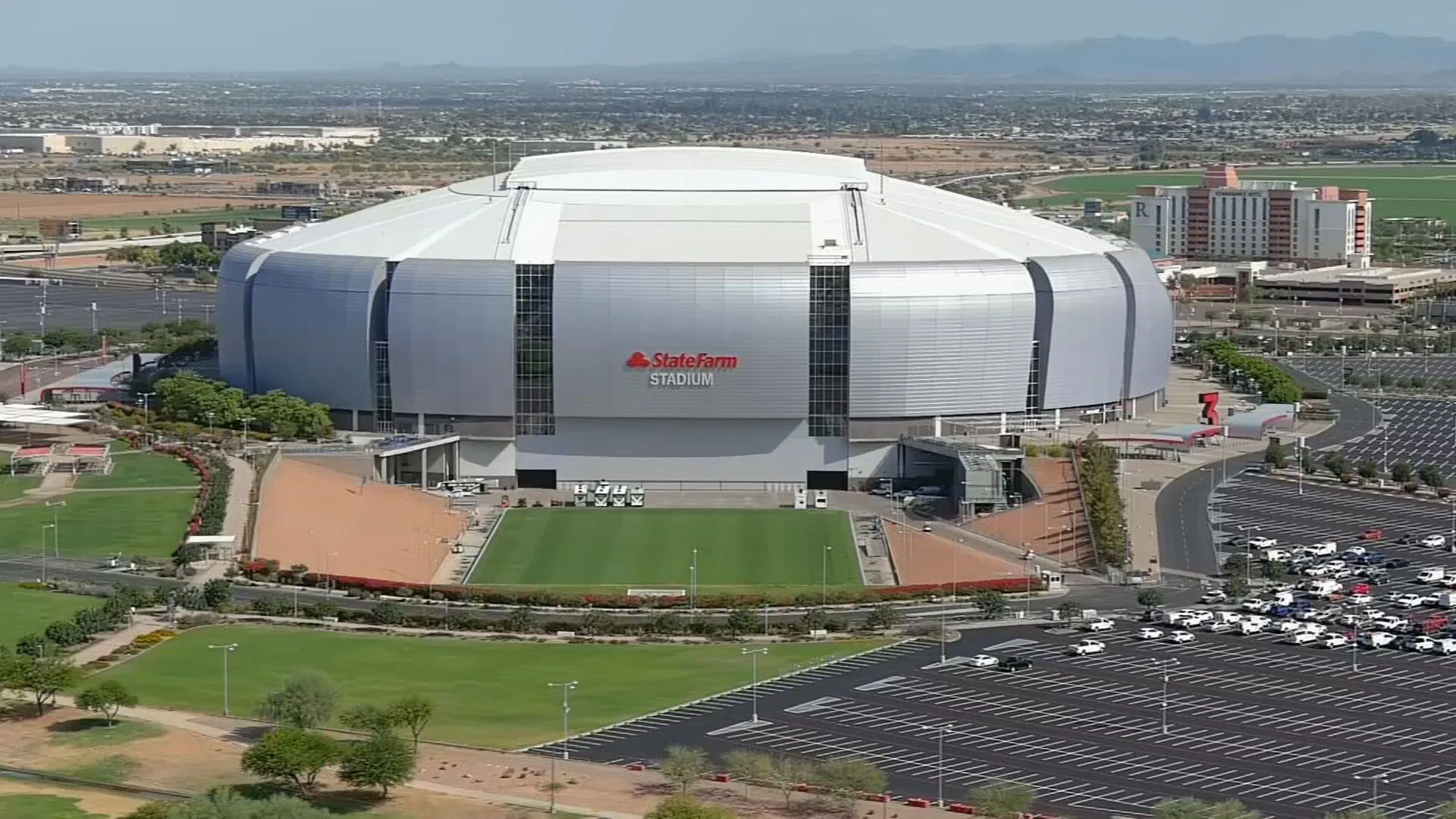
State Farm Stadium is home to the Arizona Cardinals and sits about seventeen miles northwest of downtown Phoenix and twenty-two miles from Tempe. Its retractable roof and roll-out natural grass field make it an unusual venue choice for trade show exhibitors, but for large-scale consumer activations, Super Bowl-week sponsor programs, college championship hospitality builds, and multi-day corporate events that expect tens of thousands of attendees, this stadium becomes the only venue in the metro with the necessary clearance, electrical backbone, and concourse infrastructure.
Strong planning covers what exhibitors, event producers, and trade show planners need to know when coordinating booth builds, freight deliveries, labor schedules, and sponsor activations at State Farm Stadium. The project plan should turn venue rules, freight deadlines, labor windows, and exhibitor goals into a workable show schedule. It does not describe house services or official show contractor performance. It focuses instead on the logistical handoffs, move-in constraints, and jurisdictional questions that separate a stadium activation from a Phoenix Convention Center booth install, a WestWorld of Scottsdale consumer show, or a Talking Stick Resort ballroom program.
Freight arrives through a limited dock network designed for team equipment, not trade show case goods. Labor jurisdiction follows the event contract, not the stadium. Most setups involve a combination of house electrical services, show-specific EAC crews, and vendor-direct AV or staging labor. Understanding which contractor handles rigging, who approves power drops, and how load-in schedules interact with Cardinals home games or concert dates determines whether the install meets the activation deadline or the exhibitor pays for idle crew time while waiting for venue access.
Venue facts to confirm before move-in
- State Farm Stadium says it is home to the Arizona Cardinals.
- The stadium says it seats approximately 63,400 and can expand to over 72,000.
- State Farm Stadium says it features a retractable roof and a roll-out natural grass field.
State Farm Stadium Trade Show Planning Requirements
- Retractable-roof and roll-out field configuration creates unusual floor-load, rigging-point, and clearance questions that do not come up at standard expo halls and require early coordination with house operations
- Freight routing through Cardinals loading docks rather than convention-center receiving means fewer simultaneous unload positions, longer queue windows, and more rigid appointment timing than Phoenix Convention Center or WestWorld
- Labor jurisdiction and service contractor roles vary by event contract because the stadium does not operate under a single official show contractor model, so EAC versus house crew boundaries shift event to event
- Electrical infrastructure designed for lighting and broadcast gear supports large single drops but not the distributed panel network typical of a booth-dense show floor, requiring custom power plans for multi-booth activations
- Hotel inventory in Glendale clusters near Westgate Entertainment District rather than around the stadium campus, creating a two-mile gap between lodging blocks and venue access that affects crew shuttles and early-morning load-in starts
Venue Campus and Event Footprint
State Farm Stadium occupies a purpose-built sports campus in Glendale, surrounded by parking fields and bordered by Loop 101 to the north and State Route 303 to the west. The venue holds approximately 63,400 seats in standard configuration and expands to more than 72,000 for major events. The retractable roof spans the entire seating bowl, and the natural grass playing field rolls out on a tray system to expose a fixed floor when the venue converts to event mode.
The concourse network wraps around the seating bowl in multiple levels and offers secondary activation real estate for sponsor builds, registration desks, and smaller hospitality zones. Ceiling height, column spacing, and fixture mounting points vary across concourse sections, so booth designs that work in one zone may not fit in another without structural adjustments.
- Retractable roof clearance at peak exceeds 150 feet, but rigging points tie to fixed structural beams rather than a flexible grid, requiring engineered submittals and house approval
- Roll-out grass tray creates a scheduling dependency because field-floor access cannot begin until the tray fully retracts and the concrete surface is cleaned and marked
- Concourse ceiling heights drop below 12 feet in some sections, limiting booth profile options for perimeter activations
- Loading-dock access points serve Cardinals operations, concerts, and special events through the same network, requiring advance scheduling through house logistics
Freight and Dock Coordination
State Farm Stadium freight access runs through a dock network on the stadium's west side, designed primarily to handle team equipment trucks and broadcast trailers. Unlike Phoenix Convention Center, which operates twenty climate-controlled docks dedicated to exhibit freight, State Farm Stadium docks serve multiple event types simultaneously and prioritize Cardinals operations during football season.
Inbound freight from Tempe, Phoenix, or Chandler typically routes west on I-10 to Loop 101 north, then exits at Glendale Avenue or Maryland Avenue. The drive from central Tempe runs about twenty-five minutes in off-peak traffic but stretches beyond fifty minutes during weekday morning and evening peak windows.
- West-side dock network handles simultaneous operations for Cardinals equipment, concert gear, and event freight, creating queue pressure during overlapping schedules
- I-10 to Loop 101 north route from downtown Phoenix or Tempe runs twenty-five to thirty minutes off-peak, but rush windows push travel time beyond fifty minutes
- Dock appointment windows typically run in two-hour blocks, shorter than the four-hour windows common at Phoenix Convention Center
- Detention charges accumulate when drivers wait beyond their appointment slot, and those costs flow to the exhibitor unless the contract specifies otherwise
Labor Jurisdiction and Contractor Roles
Labor jurisdiction at State Farm Stadium follows the event contract rather than a standing venue-wide agreement, so the official show contractor, house services, and EAC crews vary event to event. Some activations operate entirely under a single general contractor who holds exclusive rights to rigging, electrical, and booth labor. Other events allow exhibitors to appoint their own contractors for booth install while house services retain control of power and structural rigging.
Rigging jurisdiction almost always stays with house operations because the stadium's structural beams and roof attachment points require certified rigging crews familiar with load limits specific to the venue. Exhibitors who need to hang banners, truss, or video screens above the field floor must submit engineered drawings to house operations and schedule rigging installation through the venue's approved contractor list.
- Event-specific contractor agreements mean jurisdiction boundaries shift between activations, requiring confirmation with the show organizer before booking crew
- House electrical services control primary distribution but may or may not handle final booth connections depending on the event contract
- Rigging approval cycles run two to three weeks because house operations must review engineered submittals and verify load limits
- Rush rigging requests that arrive inside the two-week window face rejection or premium pricing that often doubles the base cost
Power, Internet, and AV Infrastructure
State Farm Stadium electrical infrastructure supports large single-point loads for broadcast trucks and lighting rigs but does not include the distributed panel network typical of a Phoenix Convention Center show floor. Exhibitors planning multi-booth activations need to work with house electrical services to design a temporary distribution system that brings power from stadium substations to custom panels near booth clusters.
Internet and data services rely on WiFi for attendee access and hardwired connections for broadcast production. Exhibitors who need reliable bandwidth for live demos or lead-capture systems should plan for hardwired drops rather than depending on venue WiFi, which degrades when thousands of attendees connect simultaneously.
- Electrical distribution designed for large single-point loads rather than dense booth grids means multi-booth activations require custom temporary panels and branch circuits
- Venue WiFi degrades under heavy attendee load, so exhibitors running live demos need hardwired data drops ordered weeks in advance through house IT services
- House video boards and sound systems support event-wide content but require custom signal formatting and house technician operation
- Independent AV vendors can deploy standalone systems for booth-level sound or LED walls but cannot connect to house infrastructure without advance approval
Hotel Blocks, Crew Lodging, and Westgate District
Hotel inventory near State Farm Stadium clusters in the Westgate Entertainment District, about two miles east of the venue along Loop 101. Properties like the Renaissance Phoenix Glendale Hotel & Spa and Hampton Inn & Suites Phoenix Glendale-Westgate serve the majority of event lodging blocks, offering shuttle access to the stadium and proximity to restaurants, retail, and nightlife that support multi-day crew stays. Those hotels fill rapidly during Cardinals home games, college championships, and concert weekends, so exhibitors planning activations at State Farm Stadium need to book crew blocks early or accept overflow lodging in Peoria, Surprise, or even downtown Phoenix with longer commute times.
Crew shuttles from Westgate hotels to the stadium loading docks typically run fifteen to twenty minutes depending on traffic and event-day road closures. Early-morning load-in starts at 5:00 or 6:00 AM see lighter traffic, but afternoon and evening pickup windows overlap with event attendee arrivals, creating congestion on Loop 101 and Glendale Avenue that can double shuttle travel time. Exhibitors who rely on crew shuttles need to budget extra time for those delays and coordinate with hotel transportation desks to confirm shuttle schedules align with dock appointments and floor access windows.
Overflow lodging in downtown Phoenix or Tempe puts crew forty-five to sixty minutes from the stadium during peak traffic periods. That distance makes sense for management teams who attend morning meetings at Phoenix Convention Center or ASU-adjacent venues before heading to State Farm Stadium for afternoon oversight, but it creates logistical friction for install crews who need to be on-site by 6:00 AM and cannot afford the commute uncertainty. Most exhibitors solve this by splitting crew lodging: install labor stays in Westgate, and management or sales teams stay in downtown Phoenix or Tempe hotels closer to other meeting commitments.
- Westgate Entertainment District hotel cluster sits two miles east of the stadium along Loop 101, providing the closest lodging blocks but filling rapidly during Cardinals games, college championships, and concert weekends, requiring early booking to secure crew rooms
- Crew shuttle travel from Westgate hotels to stadium loading docks runs fifteen to twenty minutes in off-peak windows but doubles during event-attendee arrival periods when Loop 101 and Glendale Avenue congestion peaks, requiring buffer time in crew schedules
- Overflow lodging in downtown Phoenix or Tempe creates forty-five to sixty-minute commutes during peak traffic, workable for management teams with multi-venue responsibilities but impractical for install crews who need early-morning dock access at State Farm Stadium
- Split lodging strategies place install crews in Westgate for proximity and schedule reliability while management teams stay in downtown Phoenix or Tempe to attend morning meetings at Phoenix Convention Center, Omni Tempe Hotel at ASU, or other central venues before afternoon stadium oversight
State Farm Stadium Trade Show Planning Questions
Can exhibitors use their own contractors at State Farm Stadium, or does the venue require house services for all labor?
Labor jurisdiction at State Farm Stadium varies by event contract. Some events allow exhibitors to appoint their own contractors for booth install, graphics, and AV while house services retain electrical and rigging. Other events operate under a single official show contractor with exclusive jurisdiction over all services. Exhibitors need to review the exhibitor manual and confirm contractor rules with the show organizer before booking crew. Rigging almost always stays with house operations because it involves structural attachment points and certified crews familiar with stadium load limits.
How far in advance do freight appointments need to be scheduled at State Farm Stadium?
Freight appointments at State Farm Stadium typically require scheduling at least one week in advance through house logistics or the event producer. The dock network serves Cardinals operations, concerts, and special events simultaneously, so appointment availability narrows during busy weekends. Exhibitors who wait until the week of the event often face limited time slots, longer queue windows, or instructions to reschedule delivery for overnight hours when dock congestion eases. Early coordination with the carrier and the event logistics contact prevents last-minute appointment conflicts.
What is the best freeway route from Tempe to State Farm Stadium for freight deliveries?
The most direct route from Tempe to State Farm Stadium runs west on I-10, then north on Loop 101, exiting at Glendale Avenue or Maryland Avenue depending on the dock assignment. The drive takes about twenty-five minutes in off-peak traffic but stretches beyond fifty minutes during weekday morning and evening rush windows. Carriers hauling from Mesa or Gilbert add another fifteen to twenty minutes depending on whether they use US-60 west to Loop 101 or surface streets through Tempe and Phoenix. Scheduling deliveries outside peak windows reduces travel time uncertainty and detention risk.
Does State Farm Stadium offer the same distributed power network as Phoenix Convention Center?
No. State Farm Stadium electrical infrastructure supports large single-point loads for broadcast and production gear, not the dense booth grid typical of a convention center show floor. Exhibitors planning multi-booth activations need to work with house electrical services and the event's power contractor to design a temporary distribution system with custom panels and branch circuits. That design process adds time and cost compared to tapping into existing floor boxes at Phoenix Convention Center or Mesa Convention Center. Early electrical planning prevents last-minute power shortages or rush fees.
Where should exhibitor crews stay when working a multi-day activation at State Farm Stadium?
Most exhibitor crews stay in the Westgate Entertainment District, about two miles east of the stadium along Loop 101, where properties like the Renaissance Phoenix Glendale Hotel & Spa and Hampton Inn & Suites Phoenix Glendale-Westgate offer shuttle access and proximity to restaurants and retail. Those hotels fill rapidly during Cardinals games and concert weekends, so early booking is essential. Overflow lodging in downtown Phoenix or Tempe works for management teams with multi-venue schedules but creates forty-five to sixty-minute commutes that complicate early-morning load-in starts for install crews.